
HIPAA Records Requests Drop to 15 Days. Are You Ready?
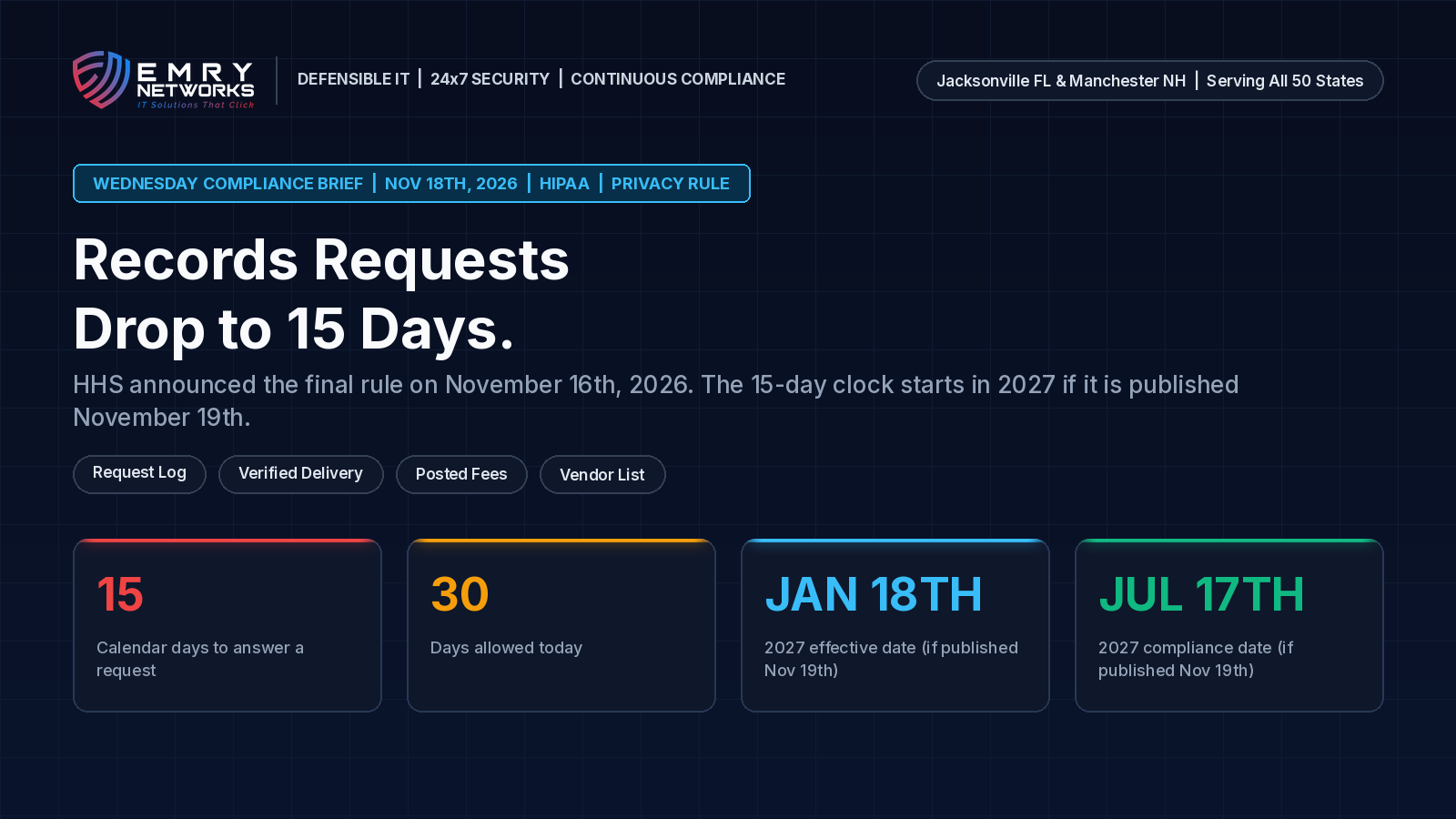
On Monday, November 16th, 2026, the HHS Office for Civil Rights (OCR) announced a final rule (RIN 0945-AA00) that changes the HIPAA Privacy Rule. The headline change, at 45 CFR 164.524: a covered entity must act on a patient's request for their records as soon as practicable, but no later than 15 calendar days after receiving it, by providing the records or issuing a written denial. The limit today is 30 days. One extension of no more than 30 calendar days stays in place, if the practice gives the patient a written statement of the reasons for the delay and the new date within those first 15 days. The 15-day period includes time spent getting more information from the patient or a vendor; it does not start over. (FR Doc 2026-23429)
The rule is scheduled to be published in the Federal Register on Thursday, November 19th, 2026. As of Wednesday, November 18th, 2026, it is on public inspection (FR Doc. 2026-23429) and is not yet the official Federal Register publication. That publication starts two clocks: it takes effect 60 days after publication, and covered entities must comply 180 days after that. (Federal Register public inspection document 2026-23429)
This brief is for owners, practice managers, and office and compliance leads at medical and dental practices, and for the vendors that support them. Nothing in the rule is due today. The point of reading it now is that a shorter clock is a process problem, and process problems take months to fix, not days.
Watch the 60-Second Briefing: Watch our narrated YouTube Short on the HIPAA records request rule, on YouTube (@emrynetworks).
What did HHS change in the HIPAA Privacy Rule?
HHS says the final rule does three things: it strengthens the individual right of access, it supports care coordination, and it reduces regulatory burdens. For a small practice, these are the changes to know. (HHS press release, November 16th, 2026; HHS fact sheet)
- Faster answers: 15 calendar days to act on a records access request, down from 30, with one extension of no more than 30 calendar days if the practice gives a written statement of the reasons and the new date within the first 15 days.
- Posted fees: if a covered entity charges for copies and has a website, it must post a fee schedule there for copies under the right of access and under an authorization, and it must also make that schedule available at the point of service and upon request (45 CFR 164.525). The rule also amends the permitted fees, including when electronic records must be provided at no charge, and requires advance notice of fees.
- Health apps: the right of access includes getting a copy of electronic records through a personal health app when the covered entity can produce them in that form and format.
- Designated recipients: patients can direct a covered entity to send an electronic copy of their electronic health record to a person they designate.
- Identity checks: the burden of identity verification on patients is reduced.
- Privacy notice: the Notice of Privacy Practices gets new content, including a new right to discuss the notice with a contact person or office the entity designates. Once the rule applies, providers with direct treatment relationships will no longer have to make a good faith effort to get a written acknowledgment.
- Care coordination: covered entities may disclose records to social services agencies, community-based organizations and similar third parties for care coordination and case management of an individual.
HHS also lists smaller changes, such as Telecommunications Relay Services providers no longer being treated as business associates. This brief focuses on what lands on a practice's front desk and IT desk.
When does the new HIPAA rule take effect?
HHS says the rule takes effect 60 days after publication and that covered entities must comply 180 days after the effective date. The dates below assume the Federal Register publishes the rule on the scheduled day. If publication slips, every date after it slips with it. The unpublished public inspection PDF (FR Doc 2026-23429) uses those same 60-day and 180-day formulas. (Federal Register public inspection document 2026-23429; The HIPAA Journal, November 17th, 2026)
- Thursday, November 19th, 2026: scheduled Federal Register publication.
- Monday, January 18th, 2027: effective date, 60 days after publication.
- Saturday, July 17th, 2027: compliance date, 180 days after the effective date.
Business associate agreements get extra time, but only for amending the contracts. The unpublished rule text at 45 CFR 164.532(e) (public inspection PDF, FR Doc 2026-23429) deems a written agreement that already complied with the HIPAA Rules and was in place before publication to remain compliant until the earlier of a renewal or modification on or after the compliance date, or January 18th, 2028, which the unpublished text hardcodes at 45 CFR 164.532(e)(2)(ii). That relief applies only if the agreement is not renewed or modified between the effective date and the compliance date. The 15-day access clock still applies on the compliance date even if the agreement has not yet been amended. If Federal Register publication slips from November 19th, 2026, confirm the dates in the official edition. Check the official published rule, or ask your attorney, before you rely on those dates.
Does this matter for a small medical or dental practice?
Yes. This is our view, not HHS's. The clock is the part most offices cannot see. Today a 30-day limit hides a lot of loose handling: a request that sits in a shared inbox, a form handed to the wrong person, a records vendor that answers when it can. At 15 days, a week of delay is half your time.
Three places tend to break first:
- Intake: requests arrive by portal, email, fax, phone and walk-in. If nobody logs the date received, nobody knows the due date.
- Delivery: electronic copies may go through the patient portal, a records vendor, or a health app the patient chose. Each path needs an owner, an identity check and a log of what was sent.
- Vendors: your electronic health record system, patient portal and release-of-information vendors all touch these requests. We covered the same vendor pattern in our brief on medical group HIPAA risk analysis and audit log review.
None of this changes the HIPAA Security Rule. A faster, more electronic access process makes the Security Rule basics matter more: who can send records, from where, and whether anyone would notice a wrong one.
How does Standard IT differ from Defensible IT on records requests?
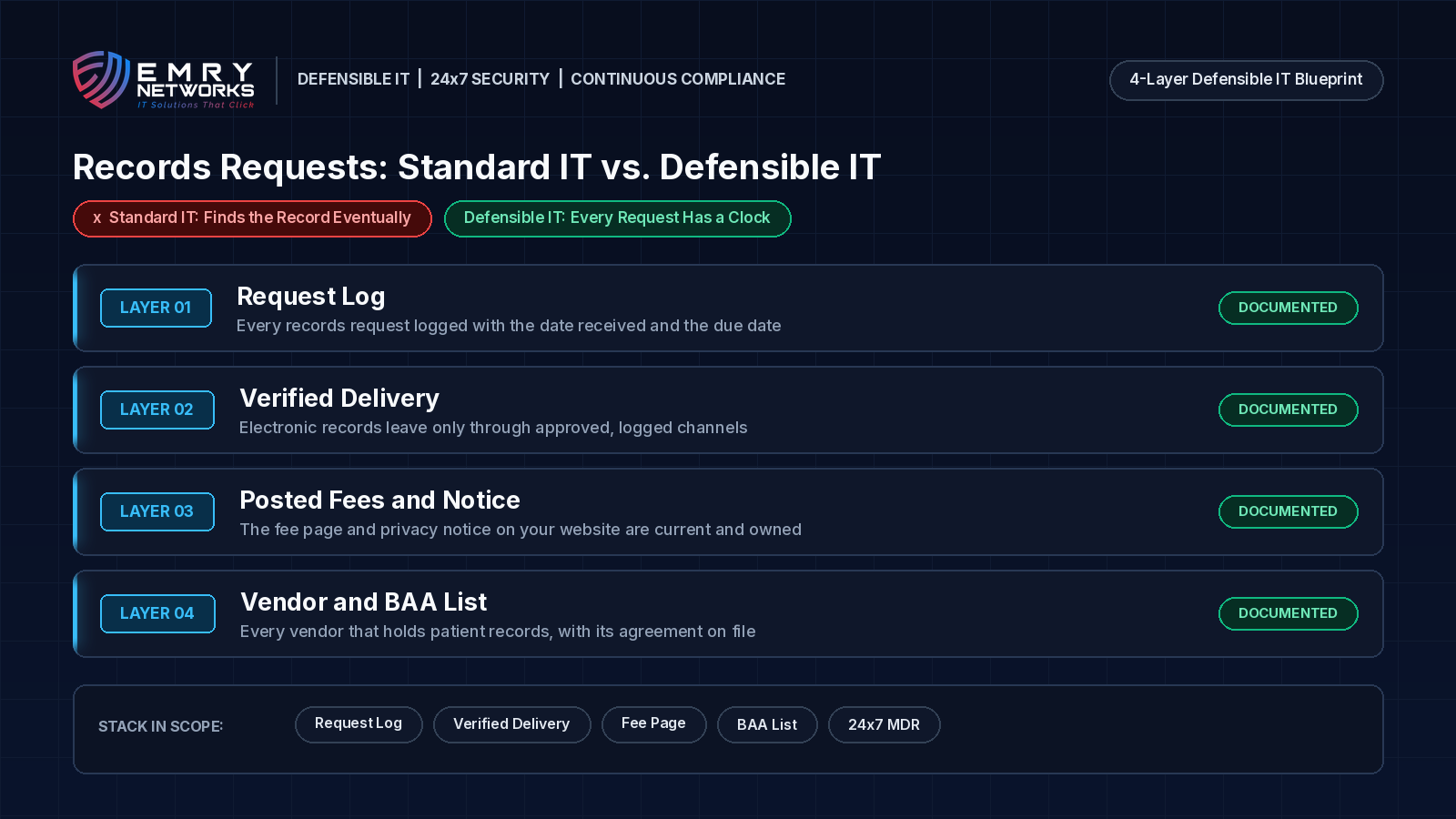
Standard IT treats a records request as a one-off task. Defensible IT treats it as a tracked event with a due date, an owner and a record.
Standard IT finds the record eventually. Defensible IT can show the received date, the due date, the identity check, how the copy went out, and that the 15-day clock was met.
Standard IT looks like this:
- Requests tracked in inboxes and memory, with no written due date.
- Electronic records sent by whoever has access, through whatever channel is handy.
- A fee page and privacy notice nobody owns, last edited when the website was built.
- A vendor list that lives in one person's head, with agreements in a filing cabinet.
Defensible IT looks like this:
- A request log with the date received, due date and status for every request, set up through compliance-first managed IT services.
- Approved delivery paths for electronic records, with named accounts, MFA and a log of what was sent, backed by 24x7 managed detection and response.
- A named owner for the fee page and privacy notice on your website, with a review date.
- A current vendor and business associate agreement list, kept as dated evidence in an IT compliance program.
What should your practice check this week?
Here is a simple way to start, in about an hour with your office manager and your IT provider. Write down four things:
- Who receives requests: every way a request can arrive, and who checks each one daily.
- How the due date is set: where the received date is recorded, and who sees the due date.
- How records leave: each system, vendor or account that can send a copy, and whether each send is logged.
- Who owns the website page: the person who keeps the fee schedule and privacy notice current.
If a box stays empty, that is your first finding. Practices with several locations or a records vendor should do this per location.
How does Emry Networks help regulated businesses in Jacksonville FL, Manchester NH, and nationwide?
Emry Networks provides managed IT, cybersecurity, and IT compliance program support for medical and dental groups, law firms, financial advisors, defense contractors, logistics firms, and other regulated industries. We serve regulated SMBs nationwide from hubs in the Jacksonville, FL and Manchester, NH areas. Pricing is all-inclusive and flat monthly, so overnight incident response does not bring a surprise invoice. Every engagement follows the 3-phase Emry Assurance Roadmap (often delivered as a 90-day blueprint):
- Phase 1 - Red Zone (Regulatory Discovery): Map how records requests arrive, who answers them, how electronic records leave, and which vendors hold patient data.
- Phase 2 - Transition (Security Hardening Sprint): Set up the request log, approved delivery paths with named accounts and MFA, and a current vendor and agreement list before July 17th, 2027, if the rule is published on November 19th, 2026.
- Phase 3 - Green Zone (Continuous Management & Drift Control): Review the log and the vendor list on a set schedule, and hand you dated evidence for audits and questionnaires.
Not sure where your office stands? Book a 30-Minute Risk Assessment. In thirty minutes we walk through your request process and the systems behind it, then tell you plainly what we find. Prefer the phone? Call (603) 202-3200.
What are the next steps for your team?
Start the readiness check above this week, then book a 30-Minute Risk Assessment to go through it with us.
- Book a 30-Minute Risk Assessment with our team. Prefer the phone? Call (603) 202-3200.
- Take the free Compliance Readiness Assessment to see where you stand.
- Read our brief on HIPAA risk analysis and audit log review for medical groups.
This brief is general information, not legal advice. Confirm obligations against the final rule text and with your counsel.
Frequently asked questions
What did HHS change about HIPAA records requests?
On November 16th, 2026, HHS OCR announced a final rule that, at 45 CFR 164.524, cuts the time to act on a records access request to as soon as practicable, but no later than 15 calendar days, down from 30, with one extension of no more than 30 calendar days if the practice gives a written statement of the reasons and the new date within the first 15 days. If a covered entity charges for copies and has a website, it must also post a fee schedule there and make it available at the point of service and upon request.
When must a practice comply with the new HIPAA Privacy Rule changes?
HHS says the rule takes effect 60 days after Federal Register publication and that covered entities must comply 180 days after the effective date. With publication scheduled for November 19th, 2026, that points to an effective date of January 18th, 2027 and a compliance date of July 17th, 2027. As of November 18th, 2026, the rule is on public inspection and is not yet officially published. If publication slips, those dates slip with it.
Do I have to post my copy fees on my website?
Once the rule applies to you, if you charge for copies and have a website, yes: 45 CFR 164.525 requires a fee schedule on that website for copies under the right of access and under an authorization, and the same schedule must be available at the point of service and upon request. The rule also requires advance notice of fees. If you have no website, you still have to make the schedule available at the point of service and upon request.
What changes in the Notice of Privacy Practices?
The notice content requirements change to explain patients' rights and how to exercise them, including a new right to discuss the notice with a contact person or office the covered entity designates. Once the rule applies, providers with direct treatment relationships will no longer have to make a good faith effort to get a written acknowledgment of the notice.
Do business associate agreements have to change?
HHS says regulated entities get additional time to modify business associate agreements in certain circumstances. The unpublished rule text at 45 CFR 164.532(e) (public inspection PDF, FR Doc 2026-23429) deems a written agreement that already complied with the HIPAA Rules and was in place before publication to remain compliant until the earlier of a renewal or modification on or after the compliance date, or January 18th, 2028, which the unpublished text hardcodes at 45 CFR 164.532(e)(2)(ii). That relief applies only if the agreement is not renewed or modified between the effective date and the compliance date. The 15-day access clock still applies on the compliance date even if the agreement has not yet been amended. If publication slips from November 19th, 2026, confirm the dates in the official edition. Confirm the details in the official published rule.
Next steps
See how we help businesses in your industry, or book a short call to talk through where you stand today.
Read more from our team
Explore insights on compliance and security.

Ready to strengthen your compliance?
Get hands-on assessment and guidance from our compliance experts.