
Your IT Provider Was Hacked. Could It Say What Was Taken?
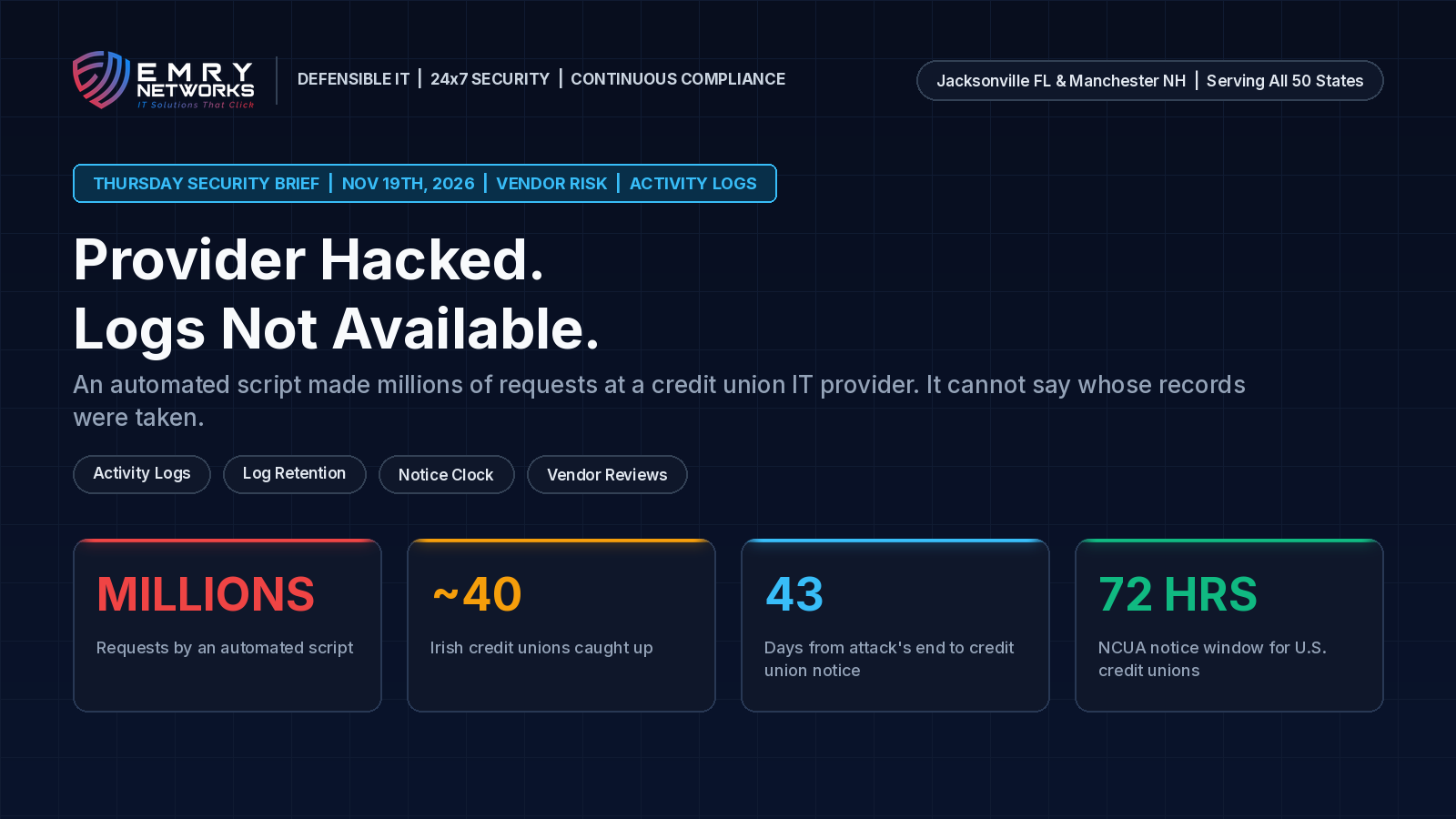
About 40 credit unions in Ireland learned this week that a shared IT provider was breached, and some have begun writing to members. The provider, Wellington IT, is a Belfast-based supplier whose services are used by about 50 credit unions, 43 of them in Ireland. (BleepingComputer, November 18th, 2026; RTE, November 18th and 19th, 2026; RTE, November 19th, 2026)
According to the provider's correspondence, as quoted by the Irish Examiner, an automated script made millions of requests (five million, per the Irish Examiner; the Irish Times reports 1.4 million from the same correspondence) to exploit an "authorisation flaw" in its platform from October 2nd to 4th, 2026. The requests came from an automated client using a valid member login, and the attacker reached saved payee records. Then the hard part: "The logs that would identify which members were requested or what each response contained are not available." So the provider is treating every saved payee record on the platform during that period as potentially affected. (Irish Examiner, November 18th, 2026; Irish Times, November 18th, 2026)
This brief is for owners, office managers, and compliance leads at regulated small and mid-sized businesses in the U.S.: credit unions and lenders, financial advisors, medical and dental practices, and law firms. You do not need to use Wellington IT for this to matter. If an outside company runs software that holds your client records, the same question applies to you: could it tell you what was taken?
Watch the 60-Second Briefing: Watch our narrated YouTube Short on the IT provider breach with missing logs, on YouTube (@emrynetworks).
What happened at Wellington IT?
Here is the timeline as the provider and one affected credit union have described it. In a statement reported by RTE on the evening of November 18th, 2026, Wellington IT's chief executive, Colin Mitchell, said the company alerted its credit union customers "as soon as the company confirmed the potential risk to customer data" and that it is working to confirm the nature and scope of the incident. The detailed wording below comes from the provider's correspondence to credit unions, as quoted by the Irish Examiner. (RTE, November 18th and 19th, 2026; RTE, November 19th, 2026)
- October 2nd to 4th, 2026: a vulnerability in the CU Online platform was exploited by an automated script that made millions of requests, according to the provider. (Wexford Credit Union member notice; Irish Examiner)
- October 6th, 2026: the vulnerability was identified and fixed, according to the Wexford Credit Union member notice. (Wexford Credit Union member notice, November 18th, 2026)
- First review: the provider's initial investigation into the October incident concluded there was "no exposure". Extortion emails sent to the provider and several credit unions had been filtered to Wellington IT's junk mail and, the provider said, had not been seen by it until a credit union flagged them on Friday, November 13th. Its engineers concluded on Sunday, November 15th that saved payee data "may have been retrieved." (Irish Examiner)
- November 16th, 2026: credit unions were told that saved payee information had been accessed. That is 43 days after the attack ended. (Wexford Credit Union member notice)
- November 18th, 2026 (evening): Wellington IT's chief executive said the company alerted its credit union customers as soon as it confirmed the potential risk to customer data. (RTE, November 18th and 19th, 2026; RTE, November 19th, 2026)
The data reached can include payee names and nicknames, IBAN and BIC codes, account numbers, sort codes, payment references and, in some cases, payee addresses. Wexford Credit Union says the provider confirmed that member account details, balances, transaction history and online banking logins were not accessed. Wellington IT has not published a confirmed number of people affected, and its chief executive said the company is still working to confirm the nature and scope of the incident. RTE has described the incident as involving payees of hundreds of thousands of credit union account holders. (Irish Examiner; Wexford Credit Union member notice; RTE, November 18th and 19th, 2026; RTE, November 19th, 2026) Ireland's Minister of State for credit unions, Robert Troy, called the provider's delay in passing on the information "not acceptable." (RTE, November 18th, 2026)
Why do missing activity logs matter so much?
This is our view, not the provider's. Activity logs are the difference between "these records were opened" and "assume everything was." When the logs that tie each request to a record are missing, three things go wrong at once:
- Scope: nobody can say which clients were affected, so every client is treated as affected.
- Notice: the business cannot write an accurate notice to clients or regulators, and the notice comes later.
- Proof: the business cannot show an examiner or insurer that it knew what its provider was doing with its data.
A valid login doing something unusual is exactly what activity logs are meant to catch. Millions of requests from one member login over a weekend is not normal member behavior. Without a record of each request, it is hard to spot during the attack and hard to scope after it.
What do U.S. rules say about activity logs and service providers?
Ireland is not under these rules. But if you run a regulated business in the U.S., several of them already require logging, provider oversight, or incident notice of the kind that was missing here. This is general information, not legal advice.
- FTC Safeguards Rule: covered non-bank financial institutions must "monitor and log the activity of authorized users and detect unauthorized access or use of, or tampering with, customer information by such users" (16 CFR 314.4(c)(8)). They must also oversee service providers by selecting capable ones, requiring safeguards by contract, and periodically assessing them (16 CFR 314.4(f)). The FTC Safeguards Rule does not apply to federally insured credit unions. (eCFR, 16 CFR 314.4)
- FTC Safeguards Rule, FTC notice: if a notification event involves the information of at least 500 consumers, a covered financial institution must notify the Federal Trade Commission as soon as possible, and no later than 30 days after discovery of the event (16 CFR 314.4(j)). That notice must include the number of consumers affected or potentially affected, which is hard to complete if a provider cannot say which records were taken. This is notice to the FTC, not a federal 30-day consumer notice. (eCFR, 16 CFR 314.4)
- HIPAA Security Rule: covered entities and business associates must implement audit controls: "mechanisms that record and examine activity in information systems that contain or use electronic protected health information" (45 CFR 164.312(b)). (eCFR, 45 CFR 164.312)
- NCUA rule for credit unions: a federally insured credit union must notify the NCUA as soon as possible, but no later than 72 hours after it reasonably believes it has experienced a reportable cyber incident, or, when the incident comes through a compromise of a credit union service organization, cloud provider or other third-party data hosting provider, within 72 hours of being notified by that third party, whichever is sooner (12 CFR 748.1(c)). (eCFR, 12 CFR 748.1)
- NCUA guidelines for credit unions: each credit union should require its service providers by contract to protect member information and, where its risk assessment calls for it, monitor them by reviewing "audits, summaries of test results, or other equivalent evaluations" (12 CFR Part 748, Appendix A, III.D). (eCFR, 12 CFR Part 748, Appendix A)
- SEC Regulation S-P: covered institutions, including SEC-registered investment advisers and broker-dealers, must maintain a response program with policies reasonably designed to ensure that a service provider notifies them as soon as possible, but no later than 72 hours after becoming aware of a security breach resulting in unauthorized access to a customer information system the provider maintains (17 CFR 248.30(a)(5)). They must also notify affected individuals as soon as practicable, but not later than 30 days, after becoming aware that unauthorized access to or use of customer information has occurred or is reasonably likely to have occurred, unless a permitted exception applies (17 CFR 248.30(a)(4)). If the firm cannot identify which individuals were affected, it must notify all whose sensitive customer information resides in the system, except those it reasonably determines were not affected. The amended rule's compliance dates were December 3rd, 2025 for larger covered institutions and June 3rd, 2026 for smaller ones. (eCFR, 17 CFR 248.30)
None of these rules let you hand the responsibility to your provider. If the provider cannot tell you what was touched, you still have to answer to your clients and your regulator.

How does Standard IT differ from Defensible IT when a provider is breached?
Standard IT treats a provider breach as the provider's problem. Defensible IT treats it as your evidence problem, settled before anything happens.
Standard IT takes the provider's word for it. Defensible IT can show which records were touched, by whom and when, from logs kept long enough to look back.
Standard IT looks like this:
- Software providers chosen on price and features, with no question asked about logs.
- No idea how long a provider keeps activity logs, or whether you can get them.
- A contract that says nothing about how fast the provider must tell you about an incident.
- A vendor list that lives in one person's head, never reviewed.
Defensible IT looks like this:
- Every provider that holds client records asked, in writing, what it logs, set up through compliance-first managed IT services.
- Your own systems logging logins and record access, watched by 24x7 managed detection and response.
- Contracts with a notice clock that fits your own reporting duty, such as the NCUA's 72 hours or Regulation S-P's 72-hour service-provider notice.
- A current vendor list with dated reviews, kept as evidence in an IT compliance program.
We covered a related pattern in our brief on outside code running on your website, and in our brief on HIPAA risk analysis and audit log review for medical groups.
What should you ask your IT and software providers this week?
Pick the three providers that hold the most client records: your core software, your client portal, and your managed IT provider. Ask each one these questions and keep the written answers.
- Who opened what? Do you log which records each login, user or automated request touched, and what was returned?
- How long? How long do you keep those logs, and how would we get a copy during an incident?
- How fast? How soon will you tell us, in writing, after you suspect an incident? Is that in our contract?
If a provider cannot answer, that is your first finding. Write it down, set a date to follow up, and add it to your vendor list.
How does Emry Networks help regulated businesses in Jacksonville FL, Manchester NH, and nationwide?
Emry Networks provides managed IT, cybersecurity, and IT compliance program support for medical and dental groups, law firms, financial advisors, credit unions and lenders, defense contractors, logistics firms, and other regulated industries. We serve regulated SMBs nationwide from hubs in the Jacksonville, FL and Manchester, NH areas. Pricing is all-inclusive and flat monthly, so overnight incident response does not bring a surprise invoice. Every engagement follows the 3-phase Emry Assurance Roadmap (often delivered as a 90-day blueprint):
- Phase 1 - Red Zone (Regulatory Discovery): List every provider that holds client records, what each one logs, how long it keeps logs, and what the contract says about notice.
- Phase 2 - Transition (Security Hardening Sprint): Turn on logging for your own logins and record access, close the gaps with your providers, and set a notice clock in contracts.
- Phase 3 - Green Zone (Continuous Management & Drift Control): Review providers on a set schedule and hand you dated evidence for audits, exams and insurance forms.
Not sure where your business stands? Book a 30-Minute Risk Assessment. In thirty minutes we walk through your providers and the logs behind them, then tell you plainly what we find. Prefer the phone? Call (603) 202-3200.
What are the next steps for your team?
Send the three questions above to your top three providers this week, then book a 30-Minute Risk Assessment to go through the answers with us.
- Book a 30-Minute Risk Assessment with our team. Prefer the phone? Call (603) 202-3200.
- Take the free Compliance Readiness Assessment to see where you stand.
- Read our brief on HIPAA risk analysis and audit log review for medical groups.
This brief is general information, not legal advice. Confirm your obligations with your counsel.
Frequently asked questions
What happened in the Wellington IT breach?
According to the provider's correspondence quoted by the Irish Examiner, an automated script made millions of requests (reports range from 1.4 million to five million) to exploit an authorization flaw in Wellington IT's CU Online platform from October 2nd to 4th, 2026, using a valid member login, and reached saved payee records. About 40 Irish credit unions are caught up. Wexford Credit Union says it was told on November 16th, 2026.
Why can't the provider say which records were taken?
According to the provider's correspondence, as quoted by the Irish Examiner, the logs that would identify which members were requested, or what each response contained, are not available. Without those logs it cannot confirm which individual records were retrieved, so it is treating all saved payee records on the platform during that period as potentially affected.
Do U.S. rules require activity logs?
Several do for regulated businesses. The FTC Safeguards Rule requires covered financial institutions to monitor and log the activity of authorized users (16 CFR 314.4(c)(8)) and to oversee service providers (16 CFR 314.4(f)). If a notification event involves at least 500 consumers, they must also notify the FTC as soon as possible and no later than 30 days after discovery (16 CFR 314.4(j)); that is notice to the FTC, not a federal 30-day consumer notice. The HIPAA Security Rule requires audit controls that record and examine activity in systems with electronic protected health information (45 CFR 164.312(b)). Under amended SEC Regulation S-P, covered institutions must have a response program reasonably designed to ensure a service provider notifies them within 72 hours of becoming aware of a qualifying breach, and they generally must notify affected individuals within 30 days (17 CFR 248.30).
How fast must a U.S. credit union report a cyber incident?
Under 12 CFR 748.1(c), a federally insured credit union must notify the NCUA as soon as possible, but no later than 72 hours after it reasonably believes it has experienced a reportable cyber incident, or, when the incident comes through a compromise of a credit union service organization, cloud provider or other third-party data hosting provider, within 72 hours of being notified by that third party, whichever is sooner.
What should I ask my IT and software providers?
Ask three questions and keep the written answers. Do you log which records each login or request touched? How long do you keep those logs, and how would we get them during an incident? How soon will you tell us, in writing, after you suspect an incident, and is that in our contract?
Next steps
See how we help businesses in your industry, or book a short call to talk through where you stand today.
Read more from our team
Explore insights on compliance and security.

Ready to strengthen your compliance?
Get hands-on assessment and guidance from our compliance experts.