
OpenSSH SSHole Flaw (CVE-2026-123158): Find Every Linux SSH Login Your Patch Report Missed

On Monday, November 9th, 2026, CISA added CVE-2026-123158, an OpenSSH flaw that researchers and security press nicknamed "SSHole," to its Known Exploited Vulnerabilities (KEV) catalog. It set a November 12th, 2026 remediation deadline for federal civilian agencies. (CISA KEV) On Linux systems where OpenSSH is built on the musl C library without PAM, such as Alpine Linux, a very long password can open accounts that were never meant to accept a password at all. OpenSSH fixed it in version 10.6p2, released November 5th, 2026. (OpenSSH 10.6p2 release notes, NVD)
For logistics and supply chain firms, the risk is rarely the laptops. It is the small Linux devices a vendor or managed service provider (MSP) set up years ago: edge gateways, file transfer servers, and appliances that still accept SSH logins. So ask one question this week: can anyone list every device that accepts a remote login, and prove each one is patched?
Watch the 60-Second Briefing: Watch our narrated YouTube Short on OpenSSH SSHole and the three MSP questions on YouTube (@emrynetworks).
What should logistics and supply chain firms take away from CVE-2026-123158?
CVE-2026-123158 shows that a monthly Windows patch cycle can miss the Linux devices that accept remote logins, and CISA already lists the flaw as exploited, with a November 12th, 2026 federal remediation deadline.
- What happened: OpenSSH released 10.6p2 on November 5th, 2026 to close a password authentication bypass. CISA added CVE-2026-123158 to KEV on November 9th, 2026, with a November 12th, 2026 federal deadline. Security firms report attacks in the wild.
- Who is affected: OpenSSH before 10.6p2 on Linux systems that use musl libc with PAM disabled, such as Alpine Linux. (Alpine Linux advisory, NVD) Some embedded builds based on Buildroot, Yocto, or OpenWrt with OpenSSH added may also be exposed. (SecurityWeek, SSD Nodes)
- What to do: Find every device running an SSH server, update to OpenSSH 10.6p2 or the vendor fix, restart the SSH service, and turn off SSH password logins.
- Standard IT vs. Defensible IT: Standard IT patches the laptops. Defensible IT can name every device that accepts a remote login, with its version, its owner, and a dated patch record.
What is CVE-2026-123158?
NVD describes CVE-2026-123158 as a password authentication bypass in sshd, the OpenSSH server, on Linux when musl libc is used without PAM. Accounts with password field *, which is normal for key-only accounts and for root on Alpine, can accept a very long password as if it were correct. OpenSSH's default PermitRootLogin prohibit-password still blocks direct root password logins unless that setting was changed; other * accounts remain at risk. The CVE carries a CVSS score of 8.1, rated High. (NVD, Alpine Linux advisory)
Is it being exploited?
Yes. CISA added it to KEV on November 9th, 2026, which means CISA has evidence of exploitation. BleepingComputer reports that GreyNoise recorded successful exploitation in the wild, with attackers running reconnaissance and trying to add their own SSH keys for persistent access. CISA lists known ransomware campaign use as unknown. (BleepingComputer)
Which systems are affected and which are not?
Affected: OpenSSH before 10.6p2 on musl-based Linux with PAM disabled and SSH password logins turned on (the OpenSSH default). Alpine Linux is the best-known example, and Alpine published fixed packages for its supported releases. (Alpine Linux advisory, NVD) Not affected: glibc-based systems such as Ubuntu, Debian, and Fedora, according to Detectify (November 5th, 2026) and the NVD condition that the flaw applies when musl libc is used; OpenSSH set up to use PAM, and any server with SSH password logins turned off, according to the Alpine advisory; and the Dropbear SSH server that stock OpenWrt ships, according to SSD Nodes (November 9th, 2026, secondary). A router is in scope only if the openssh-server package was added and password logins were left on. (Detectify, NVD, Alpine Linux advisory, SSD Nodes)
Why does this matter for a logistics or supply chain firm?
It matters because warehouses, yards, and fleets run small Linux devices that an MSP or a vendor installed and still reaches over SSH, and those devices rarely appear in a monthly patch report.
Regional carriers, distributors, and third-party logistics providers often run more Linux than they realize: gateways at each site, a file transfer server that trades data with customers, containers behind a shipping portal, and appliances that came with a warehouse system. Many were set up by a vendor and handed to an MSP. If nobody owns the box, nobody patches the box, and nobody notices when SSH still accepts passwords.
Your customers and auditors still hold you responsible. Shippers send security questionnaires, cyber insurers ask about remote access, and firms that move goods for defense customers may handle Controlled Unclassified Information, where NIST SP 800-171 and CMMC expect you to monitor and control remote access sessions. Our guide to which compliance framework applies to your business covers how these overlap.
Is "we patched everything" enough for an auditor?
No. An auditor or customer will ask which systems accept remote logins, what version each one runs, and when it was last patched. A Windows patch report does not answer that for the Linux gateway in the warehouse.
What five questions should a logistics firm ask its MSP this week?
Ask for dated answers in writing. These five questions test whether every SSH login is inventoried, patched, and set to key-only, beyond a patch report for the laptops.
- Which devices run an SSH server, and is it OpenSSH or Dropbear, at what version? Include servers, appliances, gateways, and containers.
- Which of those run Alpine or another musl-based build without PAM? These are the ones to fix first.
- Were they updated to OpenSSH 10.6p2 or the vendor fix, and was sshd restarted? Updating the package alone does not replace the running service.
- Are SSH password logins turned off on every device? Ask for the setting per device, plus the list of MSP and vendor keys that can still log in.
- Who reviews SSH logins and new SSH keys overnight, and where is that logged? Name the person or MDR team and the evidence location.
Save the answers, dates, and reviewer name in your security evidence folder.
What if a device was exposed or shows odd SSH logins?
Patch or turn off password logins first, then treat the device as possibly exposed. Review successful password logins to accounts that should be key-only, check for SSH keys nobody approved and for new accounts or startup services, preserve logs before cleanup, and open incident response if anything does not match a known user or vendor.
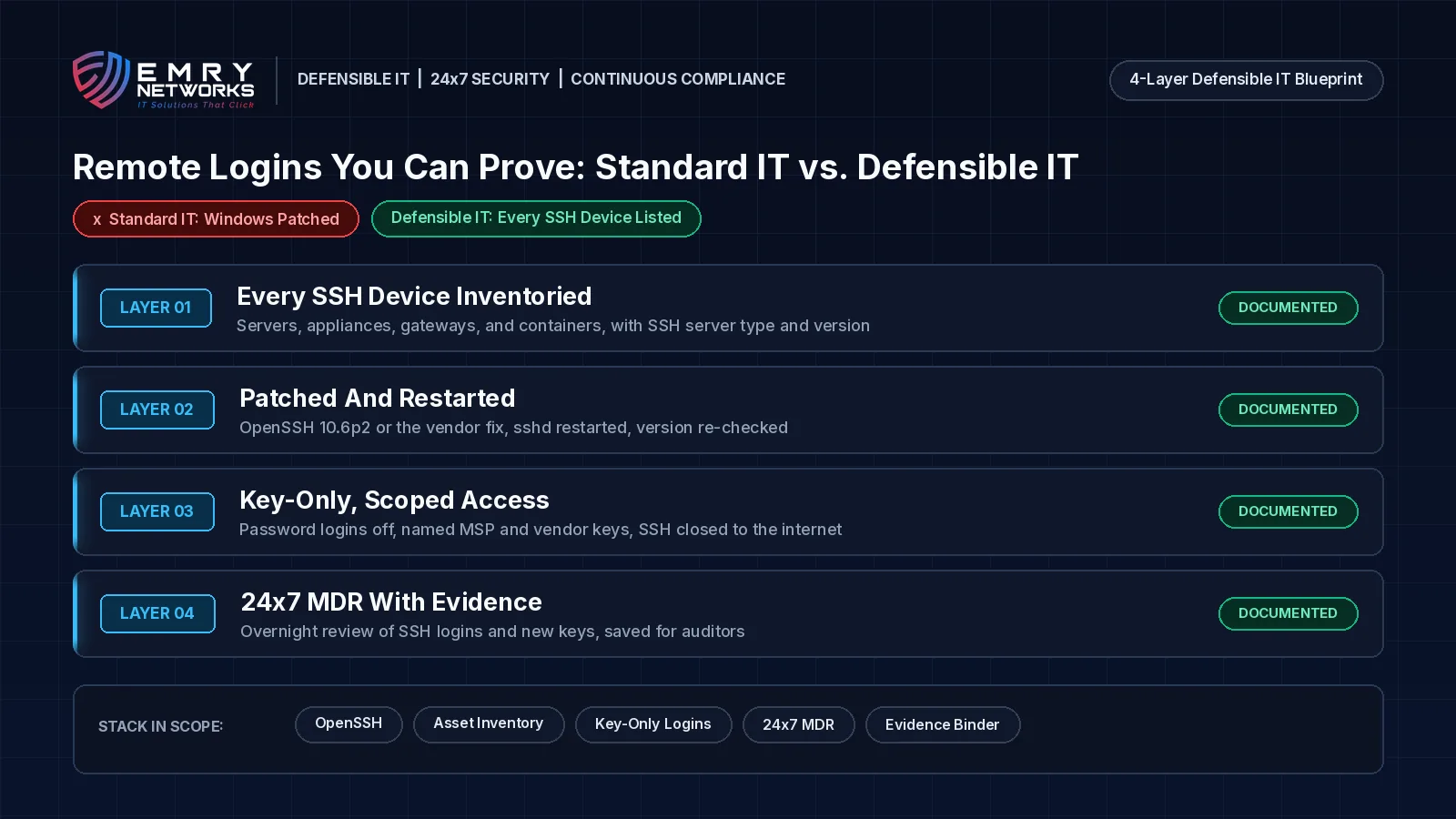
How does Standard IT differ from Defensible IT after CVE-2026-123158?
Standard IT patches the laptops and servers it knows about. Defensible IT keeps a dated list of every device that accepts SSH, the version it runs, which MSP and vendor keys can reach it, and who reviewed overnight logins.
Standard IT says "we patched." Defensible IT can show the SSH inventory, the per-device patch and restart record, the key-only setting, and the 24x7 case notes, with dates.
Standard IT looks like this:
- Windows patched monthly; Linux devices left to whoever installed them.
- SSH password logins left at the default.
- Shared or unnamed vendor and MSP logins.
- No dated list of remote login points when a customer or auditor asks.
Defensible IT looks like this:
- An inventory of every device running an SSH server, kept current through compliance-first managed IT services.
- Patches tracked per device, with CISA KEV items treated as urgent (the November 12th, 2026 date is the federal civilian deadline and a useful private-sector benchmark, not a CMMC or customer-contract clock unless your agreements say otherwise).
- Key-only SSH logins, named MSP and vendor keys, and SSH closed to the internet unless there is a written reason.
- 24x7 managed detection and response so an odd 2 a.m. SSH login gets a human response that night, with dated notes saved to your evidence folder.
How does Emry Networks help regulated businesses in Jacksonville FL, Manchester NH, and nationwide?
Emry Networks provides managed IT, cybersecurity, and IT compliance program support for logistics and supply chain firms, medical and dental groups, law firms, financial advisors, defense contractors, and other regulated industries. We serve regulated SMBs nationwide from hubs in the Jacksonville, FL and Manchester, NH areas. Pricing is all-inclusive and flat monthly, so overnight incident response does not bring a surprise invoice. Every engagement follows the 3-phase Emry Assurance Roadmap (often delivered as a 90-day blueprint):
- Phase 1 - Red Zone (Regulatory Discovery): Inventory every device that accepts remote logins, map MSP and vendor access, and deploy EDR, logging, and device management.
- Phase 2 - Transition (Security Hardening Sprint): Patch and restart affected SSH servers, turn off password logins, close SSH to the internet, and route login alerts to 24x7 coverage.
- Phase 3 - Green Zone (Continuous Management & Drift Control): Retest the inventory, confirm versions stay current, and hand you dated before-and-after evidence for customers and auditors.
Not sure every SSH device would pass this check? Book a 30-Minute Risk Assessment. In thirty minutes we review remote login points, patch evidence, and MSP access, then tell you plainly what we find. Prefer the phone? Call (603) 202-3200.
What are the next steps for your logistics firm?
Get a written inventory of every device that accepts SSH, confirm each musl/no-PAM system is patched and restarted (or has password logins turned off), then book a 30-Minute Risk Assessment if you want a second review of those login paths.
- Book a 30-Minute Risk Assessment with our team. Prefer the phone? Call (603) 202-3200.
- Take the free Compliance Readiness Assessment to see where you stand.
- Read our guide on which compliance framework applies to your business.
Frequently asked questions
What is the OpenSSH CVE-2026-123158 (SSHole) vulnerability?
It is a password authentication bypass in the OpenSSH server on Linux systems that use musl libc without PAM, such as Alpine Linux. A very long password can open accounts that were never meant to accept one, including key-only accounts and root on Alpine. OpenSSH's default PermitRootLogin prohibit-password still blocks direct root password logins unless that setting was changed; other * accounts remain at risk. OpenSSH fixed it in version 10.6p2 on November 5th, 2026.
Is CVE-2026-123158 being exploited?
Yes. Security firms report attacks in the wild, and CISA added the flaw to its Known Exploited Vulnerabilities catalog on November 9th, 2026, with a November 12th, 2026 federal civilian deadline.
How do I fix it?
Update to OpenSSH 10.6p2 or your vendor's fixed package, then restart the SSH service, because updating alone does not replace the running server. If you cannot update yet, turn off SSH password logins.
What should a logistics firm ask its MSP?
Which devices run an SSH server and at what version, which run musl-based builds without PAM, whether they were patched and restarted, whether SSH password logins are turned off everywhere, and who reviews SSH logins overnight.
How does 24x7 MDR differ from a business-hours ticket queue?
A business-hours queue may not see an odd 2 a.m. SSH login until the next morning. 24x7 managed detection and response puts a person on that alert the same night and leaves dated evidence for your security file.
Next steps
See how we help businesses in your industry, or book a short call to talk through where you stand today.
Read more from our team
Explore insights on compliance and security.

Ready to strengthen your compliance?
Get hands-on assessment and guidance from our compliance experts.