
6.4 Million Stolen Logins: Is Your Practice's MFA Answer True?
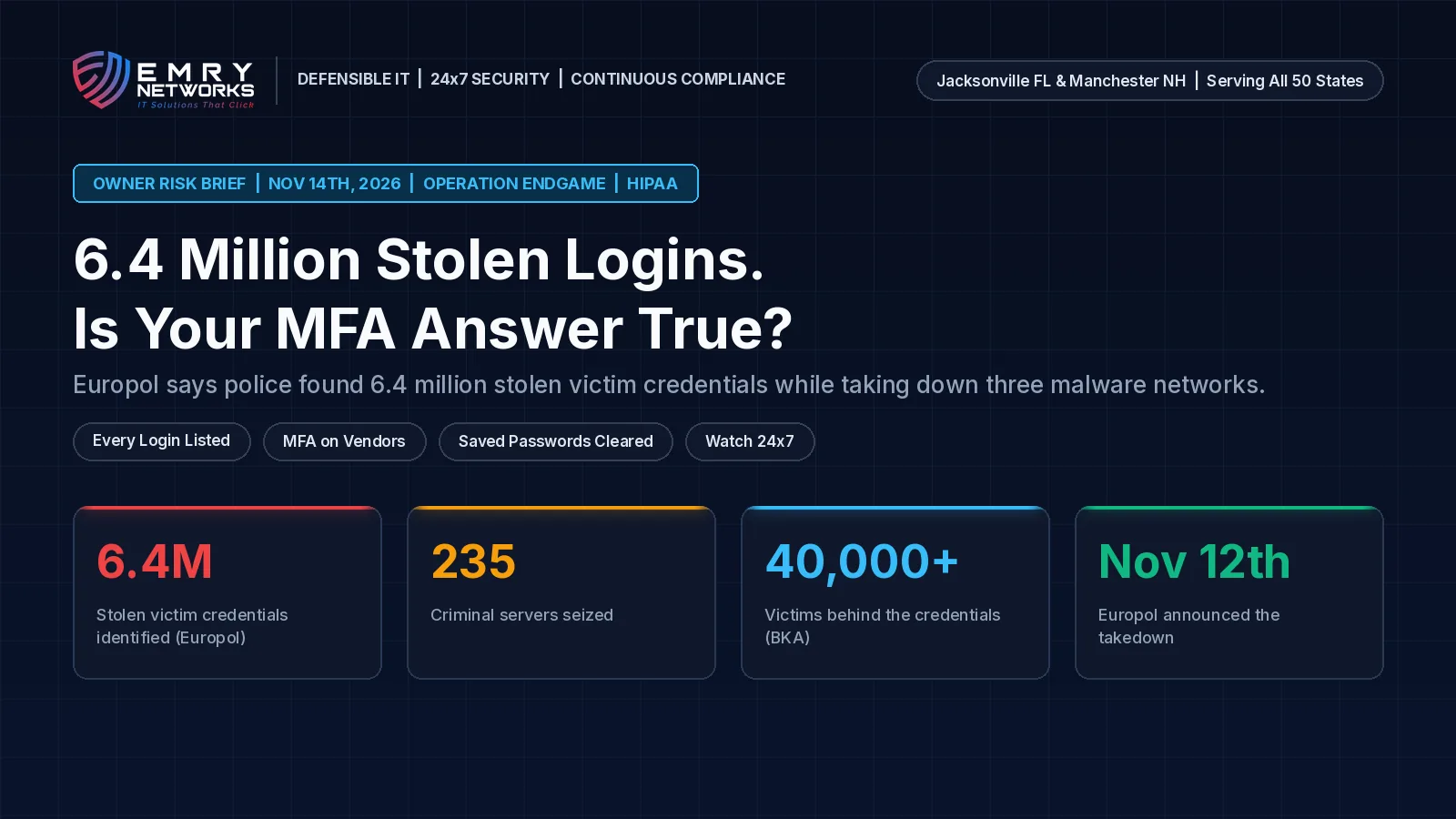
On Thursday, November 12th, 2026, Europol announced that Operation Endgame, working with law enforcement in nine countries including the FBI, had dismantled the criminal infrastructure behind three malware networks: Gootloader, CastleRAT, and StealC. Law enforcement seized 235 servers and 257 domains and identified 6.4 million stolen victim credentials. (Europol) Germany's Federal Criminal Police Office (BKA) says the credentials came from more than 40,000 victims. (BKA)
This is a weekend brief for owners and CFOs of medical and dental practices. You do not need to understand malware to act on it. You need to know which logins can reach your practice, whether each one has a second sign-in step, and whether the answer you gave your cyber insurer is true, including for your IT vendor.
Watch the 60-Second Briefing: Watch our narrated YouTube Short on stolen logins, vendor MFA, and your cyber insurance answers, on YouTube (@emrynetworks).
What should practice owners take away from Operation Endgame?
Stolen logins are a business risk, not only an IT problem. Europol says StealC was built to pull passwords, stored access data, and digital identities from infected computers. Europol also says the stolen credentials found in the seized infrastructure were sold for later attacks, including ransomware.
- Who is affected: any practice whose staff or vendors save passwords in a web browser or reuse them across sites.
- What happened: police took down the servers behind three malware networks and found 6.4 million stolen credentials.
- What to verify now: every staff and vendor login that reaches email, remote access, and your practice systems, and whether each uses MFA.
- Why it matters for insurance and HIPAA: cyber insurance applications ask about MFA. The current HIPAA Security Rule expects access controls, authentication, and a current risk analysis, but it does not name MFA as a required control. A January 2025 proposed update would require MFA. That rule has not been finalized.
What did Operation Endgame take down?
Europol describes three toolkits. Gootloader spread through fake legal documents on hacked WordPress sites and led to ransomware. CastleRAT is a remote access trojan that let attackers control infected computers; Europol says its use led to encrypted data and ransom payments. StealC is a stealer designed to extract passwords, stored access data, and digital identities for data trading and fraudulent use. The BKA says the coordinated action ran from November 9th to 11th, 2026.
Does this mean my practice's data is in it?
Not necessarily, and nobody can tell you from a headline. Europol says victim data will be shared through services such as Have I Been Pwned, alerting victims of stolen credentials caused by the CastleRAT malware. (Have I Been Pwned) That does not mean all 6.4 million credentials will appear there. A clean lookup is useful, but it is not proof. The better question is whether a stolen password alone would be enough to get into your practice.
Why do stolen logins matter to a medical or dental practice?
Your practice runs on logins: email, the practice management system, imaging, billing portals, and remote access for the doctor at home. Your IT provider has logins too, often with more reach than anyone on staff.
- Saved passwords go first. Front-desk and billing PCs that save logins in the browser hold exactly what infostealers are built to collect.
- Vendors count. A stolen password from your IT provider's technician can reach every PC in the practice. Under HIPAA, an IT vendor that handles protected health information is a business associate, and you are expected to have a business associate agreement and to oversee that relationship. (HHS sample BAA provisions)
- MFA is the backstop. With a second sign-in step, a stolen password alone is not enough. Gaps tend to hide in vendor accounts, shared logins, and old remote access tools.
What do cyber insurance forms ask about MFA?
Many cyber insurance applications ask some version of the same questions: is MFA required for email, for remote access, and for administrator accounts, and does it apply to vendors? Your answers are part of the application. If you answer yes and a later review finds an exception, such as one vendor account without MFA, underwriting, renewals, and audits can get harder. That is not a guaranteed claim denial. The outcome depends on the policy and the facts. The cost shows up as downtime, audit rework, higher premiums, and slower deals with partners who ask for proof.
Is 'our IT company handles it' a safe answer?
No. You sign the application, not your IT provider. Ask for a dated MFA report that lists every account, including vendor and service accounts, before you answer.
What three questions should you ask your IT provider this week?
Send these in writing and keep the replies with your HIPAA risk analysis (HHS Security Rule).
- Which staff and vendor accounts can reach our email, remote access, and practice systems? Ask for the list, including shared and service accounts.
- Does every remote and vendor login use MFA? Ask for the report with a date, and a written list of any exceptions.
- Are saved browser passwords turned off on shared and front-desk PCs? And are passwords reset after any malware alert?
What if something looks wrong?
If you find a login nobody recognizes, sign-ins from odd places, or a staff PC with a malware alert, reset the affected passwords from a clean device, end active sessions, and bring in incident response before you call it closed.
How does Standard IT differ from Defensible IT on stolen logins?
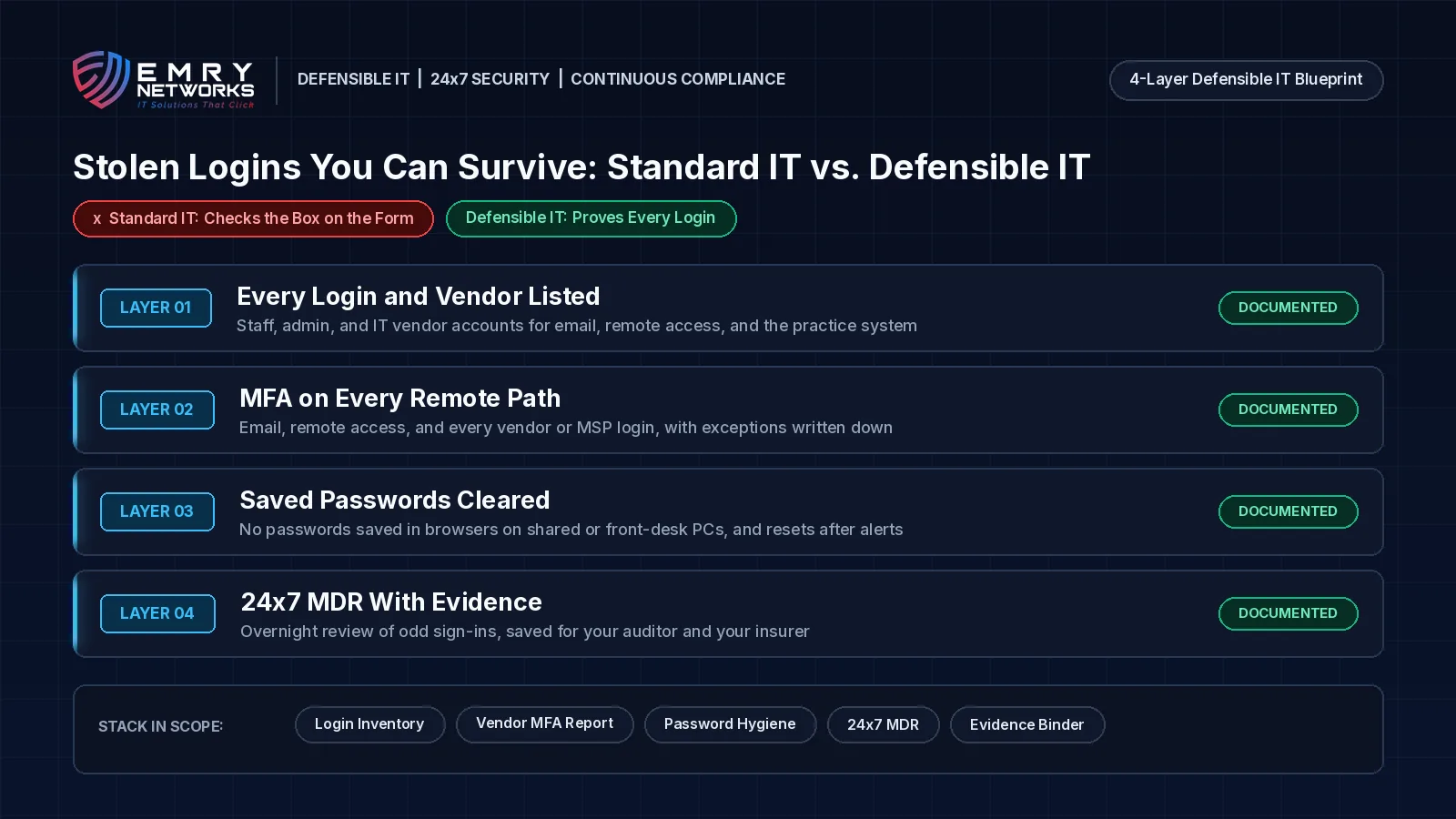
Standard IT answers yes on the insurance form and hopes nobody checks. Defensible IT keeps a dated inventory of every login and vendor, proves MFA on every remote path, and reviews odd sign-ins overnight.
Standard IT says 'we have MFA.' Defensible IT can show every account, every exception, and the date it was last checked.
Standard IT looks like this:
- No list of which vendor accounts can reach the practice.
- Passwords saved in browsers on shared PCs.
- MFA on the doctor's email, but not on the IT vendor's remote access.
- Insurance answers copied from last year's form.
Defensible IT looks like this:
- A current login and vendor inventory, kept through compliance-first managed IT services.
- MFA on email, remote access, and every vendor login, with exceptions written down and closed.
- Saved browser passwords turned off on shared PCs, and resets after every alert.
- 24x7 managed detection and response so an odd 2 a.m. sign-in gets a human response that night, with dated notes saved for your auditor and your insurer.
How does Emry Networks help regulated businesses in Jacksonville FL, Manchester NH, and nationwide?
Emry Networks provides managed IT, cybersecurity, and IT compliance program support for medical and dental groups, law firms, financial advisors, defense contractors, logistics firms, and other regulated industries. We serve regulated SMBs nationwide from hubs in the Jacksonville, FL and Manchester, NH areas. Pricing is all-inclusive and flat monthly, so overnight incident response does not bring a surprise invoice. Every engagement follows the 3-phase Emry Assurance Roadmap (often delivered as a 90-day blueprint):
- Phase 1 - Red Zone (Regulatory Discovery): Inventory every login, vendor account, and remote access path, and check each against your insurance answers.
- Phase 2 - Transition (Security Hardening Sprint): Turn on MFA everywhere it is missing, clear saved passwords, and route sign-in alerts to 24x7 coverage.
- Phase 3 - Green Zone (Continuous Management & Drift Control): Recheck the login inventory every month, confirm nothing drifted, and hand you dated evidence for renewals and audits.
Not sure your insurance answers are true? Book a 30-Minute Risk Assessment. In thirty minutes we review your logins, vendor MFA, and insurance answers, then tell you plainly what we find. Prefer the phone? Call (603) 202-3200.
What are the next steps for your team?
Book a 30-Minute Risk Assessment to review your logins, vendor access, and insurance answers. Before that call, pull last year's cyber insurance application and ask your IT provider for its MFA report.
- Book a 30-Minute Risk Assessment with our team. Prefer the phone? Call (603) 202-3200.
- Take the free Compliance Readiness Assessment to see where you stand.
- Read our guide to Standard IT vs. Defensible IT.
Frequently asked questions
What was Operation Endgame on November 12th, 2026?
Europol announced that Operation Endgame dismantled the infrastructure behind the Gootloader, CastleRAT, and StealC malware networks, seizing 235 servers and 257 domains and identifying 6.4 million stolen victim credentials.
What do infostealers like StealC take?
Europol says StealC was designed to extract passwords, stored access data, and digital identities from infected computers. Europol says the credentials found in the seized infrastructure were sold for later attacks, including ransomware.
Why do stolen logins matter to a medical or dental practice?
Email, practice systems, billing portals, and IT vendor remote access all run on logins. Without MFA, a stolen password can be enough to get in, and an IT vendor that handles patient data is a HIPAA business associate you are expected to oversee.
What do cyber insurance forms ask about MFA?
Applications commonly ask whether MFA is required for email, remote access, administrator accounts, and vendors. Your answers are part of the application, so an untrue yes can make underwriting, renewals, and audits harder. That is not a guaranteed claim denial.
How does 24x7 MDR differ from a business-hours ticket queue?
A business-hours queue may not see an odd 2 a.m. sign-in until the next morning. 24x7 managed detection and response puts a person on that alert the same night and leaves dated evidence for your security file.
Next steps
See how we help businesses in your industry, or book a short call to talk through where you stand today.
Read more from our team
Explore insights on compliance and security.

Ready to strengthen your compliance?
Get hands-on assessment and guidance from our compliance experts.