
SignDrop Zero-Day: Would Anyone at Your Firm See the Alert?
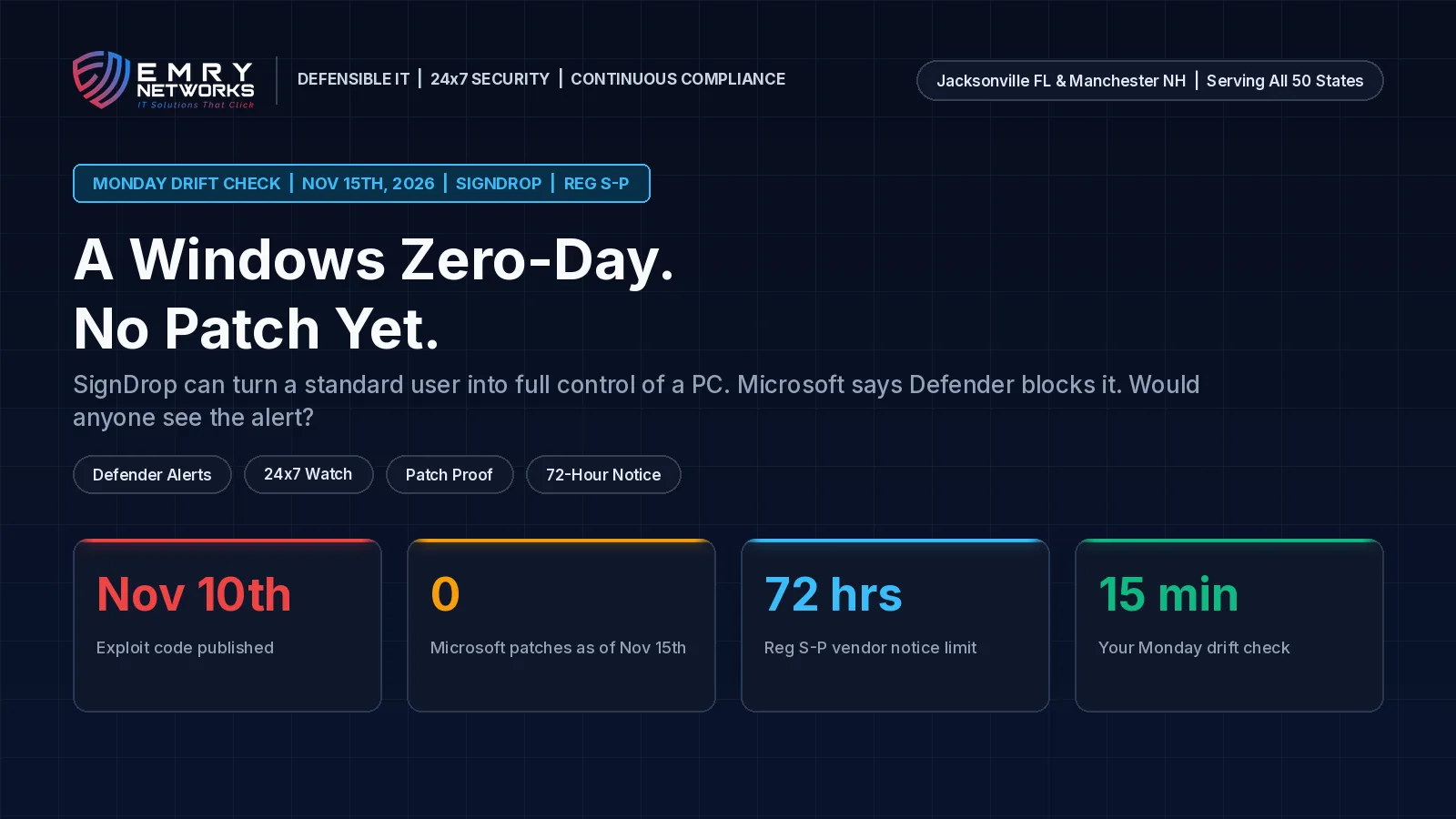
On Tuesday, November 10th, 2026, a security researcher published working exploit code for SignDrop, a Windows flaw that can turn a standard user account into full SYSTEM control of a PC. (SignDrop on GitHub) Cyderes' Howler Cell team says it rebuilt the attack in a lab and got a SYSTEM shell, and that it has found no confirmed attacks in the wild. (Cyderes) As of Sunday, November 15th, 2026, Microsoft has not released a patch or assigned a CVE. Microsoft told SecurityWeek it is investigating, that Microsoft Defender detects and blocks exploitation and alerts on the related privilege-escalation behavior, and that it has not observed exploitation in the wild. Detection is not a patch: the Windows flaw itself is still unfixed. (SecurityWeek)
This is a Sunday planning brief for principals, chief compliance officers, and operations leads at registered investment advisers. You do not need to understand Windows internals to act on it. You need fifteen minutes on Monday and three answers from your IT provider, each with a date.
Watch the 60-Second Briefing: Watch our narrated YouTube Short on SignDrop and the Monday drift check, on YouTube (@emrynetworks).
What should RIA leaders take away from SignDrop?
A zero-day with public code and no patch puts the weight on monitoring. The question for this week is not "are we patched?" because nobody can be yet. Microsoft says Defender blocks this one, but that is a detection claim, not a fix for Windows itself. So the question is "is Defender on and current on every PC, and would anyone see its alert?"
- Who is affected: Windows PCs and servers where the newer Common Log File System (CLFS) protection is turned on. The researcher estimates about 80% of Windows installs; Cyderes calls that figure unsubstantiated. Vulnerability analyst Will Dormann told Ars Technica it seems to require Windows 11 26H2 on a system more than 90 days old, and only one of his many machines met that condition. (Ars Technica)
- What happened: exploit code for a privilege escalation flaw went public on November 10th, 2026, the same day as Microsoft's November updates.
- What to verify now: Microsoft Defender (or your EDR) on and current on every PC, 24x7 review of its alerts, a plan to prove the fix reaches every PC, and written policies (backed by your IT contract) for 72-hour vendor notice.
- Why it matters for Reg S-P: the amended rule expects an incident response program and oversight of service providers, including notice within 72 hours after a security breach that results in unauthorized access to a customer information system. A published flaw or an unpatched PC, by itself, is not a notifiable incident.
What is SignDrop, in plain English?
Microsoft added a protection to the Windows log system in 2025 to block older memory-corruption attacks on it. The researcher behind SignDrop says that protection itself can be abused. A program running as an ordinary user can trick Microsoft Defender into opening a crafted log file, and Windows then creates a file with full SYSTEM rights in a place the attacker chooses. Cyderes describes the chain as a logic flaw with no memory corruption, built from normal Windows parts.
What does Microsoft say?
Microsoft told SecurityWeek on Friday, November 13th, 2026: "Microsoft is actively investigating the reported vulnerability and will take the necessary steps to update impacted products as soon as possible. Microsoft Defender detects and blocks exploitation of this vulnerability and alerts on the associated privilege-escalation behavior. At this time, we have not observed exploitation in the wild." (SecurityWeek)
Is SignDrop being used in attacks?
Not that anyone has confirmed. Cyderes says it found no confirmed exploitation in the wild as of November 10th, 2026, and Microsoft says it has not observed any. The Hacker News reports that SignDrop is not in CISA's Known Exploited Vulnerabilities catalog and that no attacks using it have been reported. (The Hacker News) Public code can change that, which is why the next few weeks matter.
Can we just turn the protection off?
No. The researcher says turning off the CLFS protection would reopen the older attacks it was built to stop. This is a decision to make with your IT provider, not a setting to flip on your own. And please do not run the public exploit code to "test" a work computer.
Why does SignDrop matter to a registered investment adviser?
SignDrop is a second-stage tool. An attacker first needs code running on a PC as a normal user, for example, from a phishing email or a malicious download. SignDrop then turns that foothold into full control.
- Defender is the safety net this time. Microsoft says Defender detects and blocks this exploit and raises an alert. That is worth checking, not assuming: is Defender on and current on every PC, and does a person read the alert? The researcher also claims the same trick could be used against other antivirus and EDR tools to get past their tamper protection. The Hacker News notes that broader claim has not been tested. Microsoft's statement covers Defender only. If your firm runs a different antivirus or EDR, ask that vendor what it says about SignDrop.
- Client data lives on those PCs. Many advisory firms keep account numbers, Social Security numbers, and statements on workstations and file shares. Full control of one PC reaches whatever that PC can reach.
- Waiting is not a plan. Until Microsoft ships a fix, Defender, monitoring, and fast response carry the load. A business-hours ticket queue may not see a 2 a.m. alert until Monday.
What does Regulation S-P expect from your IT vendor?
The SEC amended Regulation S-P in 2024. Larger entities had to comply by December 3rd, 2025, and smaller entities by June 3rd, 2026. (SEC small entity compliance guide) For most advisory firms, three parts matter this week:
- Incident response program. You need written policies and procedures to detect, respond to, and recover from unauthorized access to customer information.
- Service provider oversight. Your written policies must be reasonably designed to ensure service providers, including your managed IT provider, provide notification "as soon as possible, but no later than 72 hours after becoming aware that a breach in security has occurred resulting in unauthorized access to a customer information system maintained by the service provider." (17 CFR 248.30, eCFR) The duty sits in your firm's policies, not in a direct SEC rule on the vendor. A published vulnerability or an unpatched PC, by itself, is not that event.
- Customer notice. If sensitive customer information was, or is reasonably likely to have been, accessed without authorization, affected customers must be notified as soon as practicable and no later than 30 days after you become aware, unless a reasonable investigation shows the information is not reasonably likely to be used in a way that causes substantial harm or inconvenience.
Is "our IT company would tell us" a safe answer?
No. The rule puts oversight on your firm. A written 72-hour notice clause in your IT contract is a practical way to show that oversight, even though the rule is written as a policies-and-procedures requirement. Ask to see the clause, and make sure your incident response plan names who receives that notice.
What is the 15-minute Monday drift check?
Monday is not a regulatory deadline. It is simply a good, regular time to check. Send these three questions in writing on Monday morning and keep the replies with your Reg S-P records. Ask for a date, a number, and a screenshot, not a reassurance.
- Is Defender (or our EDR) on, current, and alerting on every PC? Ask for a dated health report, when an alert was last tested, and who reads alerts overnight.
- When Microsoft ships the SignDrop fix, how fast will it reach every PC? Ask for the target number of days and a dated report that covers 100% of PCs and servers, including laptops that are rarely in the office.
- Does our IT contract include 72-hour breach notice? Ask for the clause, and confirm it matches your incident response plan.
What if the answers take a week?
That is the finding. If nobody can say whether Defender is current on every PC, or who read last week's alerts, or how many PCs were patched last month, nobody is checking the monitoring. Write it down, set a date to close it, and bring in help if you need it.

How does Standard IT differ from Defensible IT on an unpatched zero-day?
Standard IT waits for the patch and assumes nothing happened in between. Defensible IT watches every PC until the fix lands, then proves the fix reached every machine.
Standard IT says "we'll patch when Microsoft does." Defensible IT can show the Defender health report, the overnight alert review, and the dated patch report.
Standard IT looks like this:
- Defender installed, but nobody checks that it is current or reads its alerts.
- Alerts reviewed during business hours only.
- "We patch automatically," with no report to show it.
- No vendor notice clause in the IT contract.
Defensible IT looks like this:
- Defender health and tamper alerts on every PC, tested on a schedule, through compliance-first managed IT services.
- 24x7 managed detection and response, so a 2 a.m. Defender alert gets a person that night, with dated notes saved for your compliance file.
- A dated patch report for every PC and server once Microsoft ships the fix.
- A 72-hour notice clause in the IT contract, named in your incident response plan.
How does Emry Networks help regulated businesses in Jacksonville FL, Manchester NH, and nationwide?
Emry Networks provides managed IT, cybersecurity, and IT compliance program support for financial advisors, medical and dental groups, law firms, defense contractors, logistics firms, and other regulated industries. We serve regulated SMBs nationwide from hubs in the Jacksonville, FL and Manchester, NH areas. Pricing is all-inclusive and flat monthly, so overnight incident response does not bring a surprise invoice. Every engagement follows the 3-phase Emry Assurance Roadmap (often delivered as a 90-day blueprint):
- Phase 1 - Red Zone (Regulatory Discovery): Check Defender health and alerts, patch coverage, and vendor contract terms against your Reg S-P policies.
- Phase 2 - Transition (Security Hardening Sprint): Turn on and test Defender health and tamper alerts, route them to 24x7 coverage, and add the 72-hour notice clause.
- Phase 3 - Green Zone (Continuous Management & Drift Control): Run the drift check every week, confirm nothing slipped, and hand you dated evidence for exams and audits.
Not sure your firm would see the alert? Book a 30-Minute Risk Assessment. In thirty minutes we review your Defender alerts, patch evidence, and vendor notice terms, then tell you plainly what we find. Prefer the phone? Call (603) 202-3200.
What are the next steps for your team?
Book a 30-Minute Risk Assessment to review your monitoring, patch evidence, and Reg S-P vendor terms. Before that call, send your IT provider the three Monday questions above.
- Book a 30-Minute Risk Assessment with our team. Prefer the phone? Call (603) 202-3200.
- Take the free Compliance Readiness Assessment to see where you stand.
- Read why audit readiness comes from live systems, not policies.
Frequently asked questions
What is the SignDrop Windows zero-day?
SignDrop is a Windows privilege escalation flaw whose exploit code was published on November 10th, 2026. It abuses a Common Log File System protection and Microsoft Defender to turn a standard user account into full SYSTEM control of a PC.
Is there a patch for SignDrop?
Not as of Sunday, November 15th, 2026. Microsoft has not released a patch or assigned a CVE. It says it is investigating and that Microsoft Defender detects and blocks exploitation. Detection is not a patch, and the researcher says turning off the CLFS protection is not a safe workaround.
Is SignDrop being exploited in the wild?
Cyderes, which reproduced the attack in a lab, says it found no confirmed exploitation in the wild as of November 10th, 2026, and Microsoft says it has not observed exploitation in the wild. Public exploit code can change that, so monitoring matters until a fix ships.
What does Regulation S-P require from an adviser's IT provider?
The amended rule requires written policies reasonably designed to ensure service providers notify the firm as soon as possible, but no later than 72 hours after becoming aware that a breach in security has occurred resulting in unauthorized access to a customer information system maintained by the service provider. A contract clause is one practical way to support that policy, not a separate mandate. A published vulnerability, by itself, is not that event. Smaller entities had to comply by June 3rd, 2026.
How does 24x7 MDR differ from a business-hours ticket queue?
A business-hours queue may not see a 2 a.m. Defender alert until the next morning. 24x7 managed detection and response puts a person on that alert the same night and leaves dated evidence for your compliance file.
Next steps
See how we help businesses in your industry, or book a short call to talk through where you stand today.
Read more from our team
Explore insights on compliance and security.

Ready to strengthen your compliance?
Get hands-on assessment and guidance from our compliance experts.