
SonicWall SSL-VPN MFA Bypass (CVE-2026-19868): Prove Your Clinic MFA Is Enforced
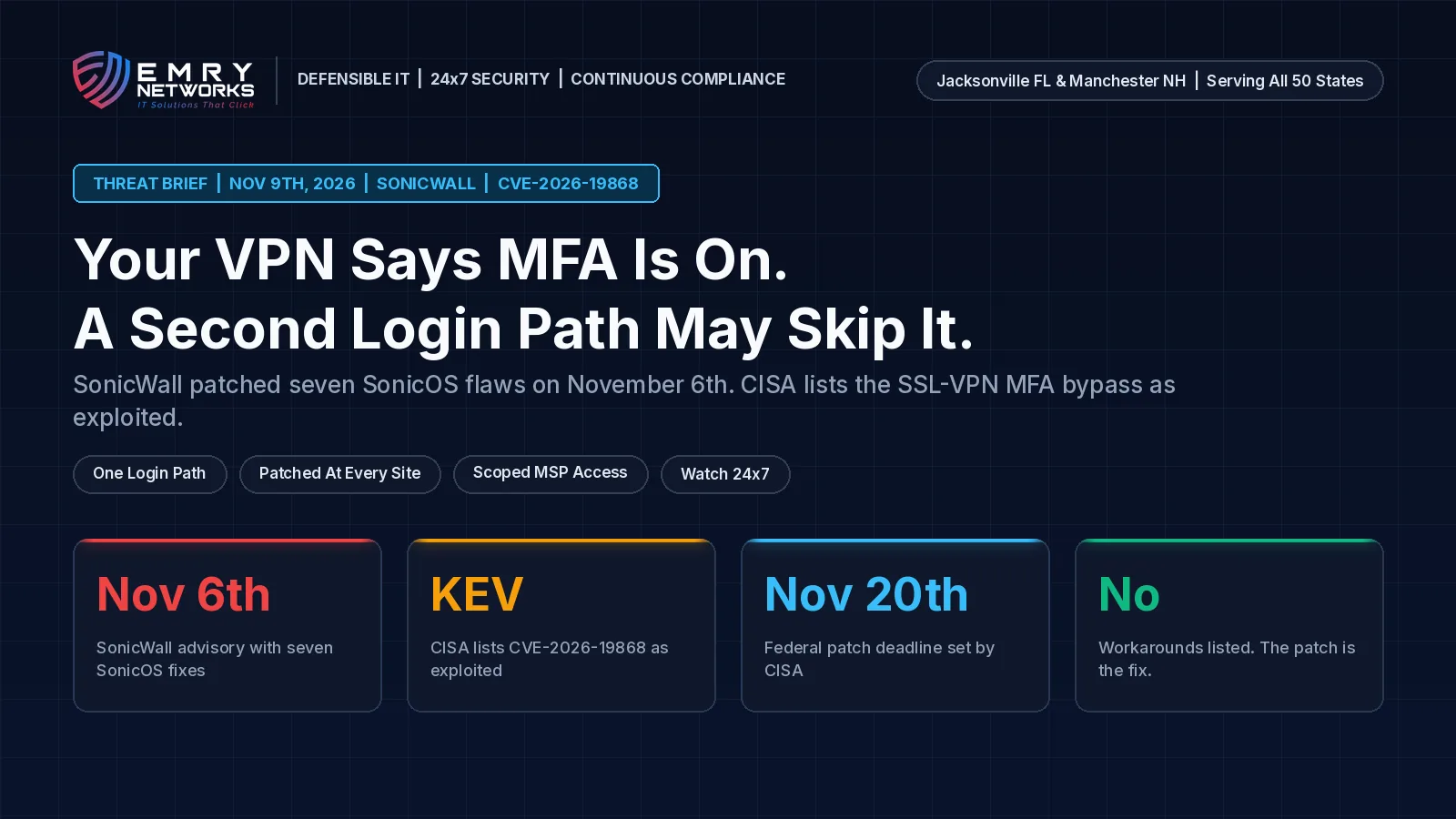
On Friday, November 6th, 2026, SonicWall published advisory SNWLID-2026-0014 and patched seven SonicOS vulnerabilities. The one that matters most this week is CVE-2026-19868. On SonicOS SSL-VPN setups that use SAML sign-in, a user with valid credentials for an alternate authentication method may bypass SAML authentication controls. Successful exploitation may also bypass SAML-enforced multi-factor authentication (MFA). SonicWall said its PSIRT investigated a report of potential exploitation. (SonicWall PSIRT, NVD)
CISA added CVE-2026-19868 to its Known Exploited Vulnerabilities (KEV) catalog on November 6th, 2026 and set a November 20th, 2026 remediation deadline for federal civilian agencies. (CISA KEV) For multi-location medical groups whose clinic firewalls are run by an outside managed service provider (MSP), this is a direct test of a simple question: is MFA enforced on every remote-access login path, at every site, and can anyone prove it?
Watch the 60-Second Briefing: Watch our narrated YouTube Short on the SonicWall SSL-VPN MFA bypass and the three MSP questions on YouTube (@emrynetworks).
What should multi-location medical groups take away from CVE-2026-19868?
CVE-2026-19868 shows that SAML MFA on SonicWall SSL-VPN is only as strong as every alternate login path still left open, and CISA already lists the flaw as exploited, with a November 20th, 2026 federal remediation deadline.
- What happened: SonicWall patched seven SonicOS flaws on November 6th, 2026. CVE-2026-19868 may let a user with valid credentials for an alternate authentication method bypass SAML sign-in and SAML-enforced MFA on SSL-VPN. CISA lists it as exploited, with a November 20th, 2026 federal deadline.
- Who is affected: SonicOS Gen7 7.3.3-7015 and earlier and Gen8 8.2.2-8015 and earlier, on SSL-VPN configured for SAML. Fixed builds reported for the advisory are Gen7 7.3.4-7013 and Gen8 8.2.3-8015. Reporting that cites SonicWall PSIRT SNWLID-2026-0014 also says SonicWall lists no workaround. (BleepingComputer, citing SonicWall PSIRT)
- What to do: Patch every clinic firewall, confirm SAML with MFA is the only SSL-VPN login method, remove leftover local and directory VPN accounts, and review which MSP accounts can reach the firewalls.
- Standard IT vs. Defensible IT: Standard IT turns MFA on. Defensible IT proves every SSL-VPN login path enforces it, with dated firmware and path evidence per clinic site.
What is CVE-2026-19868?
SonicWall and NVD describe CVE-2026-19868 as an authentication enforcement flaw in the SonicOS SSL-VPN service. If a firewall accepts SAML sign-in and also has an alternate authentication method available, a user who holds valid credentials for that alternate method may get around the SAML controls. Because MFA is often enforced through the SAML identity provider, the same path may skip MFA. CISA catalogs it as a "use of single-factor authentication" weakness (CWE-308). (CISA KEV)
Is it being exploited?
SonicWall said it investigated a report indicating potential exploitation and urged customers to upgrade as soon as possible. CISA added the flaw to KEV the same day, which means CISA has evidence of exploitation in the wild. CISA lists known ransomware campaign use as unknown, and SonicWall has not published attacker details, so do not assume or repeat any claim about who is behind it. (The Hacker News)
Which versions are affected and fixed?
Affected: SonicOS Gen7 7.3.3-7015 and earlier, and Gen8 8.2.2-8015 and earlier (NVD/MITRE). Fixed builds reported for SNWLID-2026-0014: Gen7 7.3.4-7013 and Gen8 8.2.3-8015. The same advisory also fixes two SonicOS management-interface flaws rated 8.8 and other SSL-VPN issues, so one upgrade addresses more than the MFA-bypass path alone. (NVD, BleepingComputer, citing SonicWall PSIRT)
Why does this matter for a multi-location medical group?
It matters because multi-site medical groups often inherit per-clinic SonicWall SSL-VPN configs managed by an MSP, so one leftover alternate login path can make MFA optional at that site while the group still believes "MFA is on."
Medical groups that grow by adding clinics often inherit a firewall per site, set up at different times by different people, and managed today by an MSP. Login paths diverge across sites: a local VPN account created for a vendor at one clinic, an old directory login left beside single sign-on at another. One leftover path is enough to make MFA optional for that site.
Under the HIPAA Security Rule, you must verify that a person seeking access to electronic protected health information is who they claim to be, and keep your risk analysis current. When an MSP can create, receive, maintain, or transmit electronic protected health information, or can reach systems that do, it is typically a business associate and should be under a signed business associate agreement (BAA). The risk analysis and the evidence remain yours. Groups pursuing HITRUST face the same expectation for documented access controls. Our guide to which compliance framework applies to your business covers how these overlap.
Is "we have MFA" enough for an auditor?
No. An auditor or investigator will ask which login paths exist, whether each one enforces MFA, and when the firewall was last patched. A screenshot of an MFA setting on one firewall does not answer that for every clinic in the group.
What five questions should a medical group ask its MSP this week?
Ask for dated answers in writing. These five questions test whether MFA is actually enforced on every SSL-VPN path at every clinic, beyond an MFA toggle somewhere in the console.
- Which SonicOS version does each clinic firewall run today, and when was it patched? Compare against Gen7 7.3.4-7013 and Gen8 8.2.3-8015.
- Is SAML with MFA the only SSL-VPN login method at every site? Ask for the configuration export or a screenshot per firewall.
- Which local or directory VPN accounts still exist, and who approved each one? Remove or disable anything without an owner.
- Which MSP admin accounts can reach our firewalls, and do they use MFA and least privilege? Confirm the BAA covers that access.
- Who reviews VPN logins overnight, and where is that logged? Name the person or MDR team and the evidence location.
Save the answers, dates, and reviewer name in your HIPAA evidence folder.
What if a firewall is unpatched or shows odd VPN logins?
Patch first, then treat the SSL-VPN as possibly exposed. Review SSL-VPN login logs since at least early November for successful logins through non-SAML methods, reset credentials for any alternate-method accounts, preserve logs before cleanup, and open incident response if anything does not match a known user. If patient data could have been reached, involve your privacy officer for a HIPAA breach risk assessment.
How does Standard IT differ from Defensible IT after CVE-2026-19868?
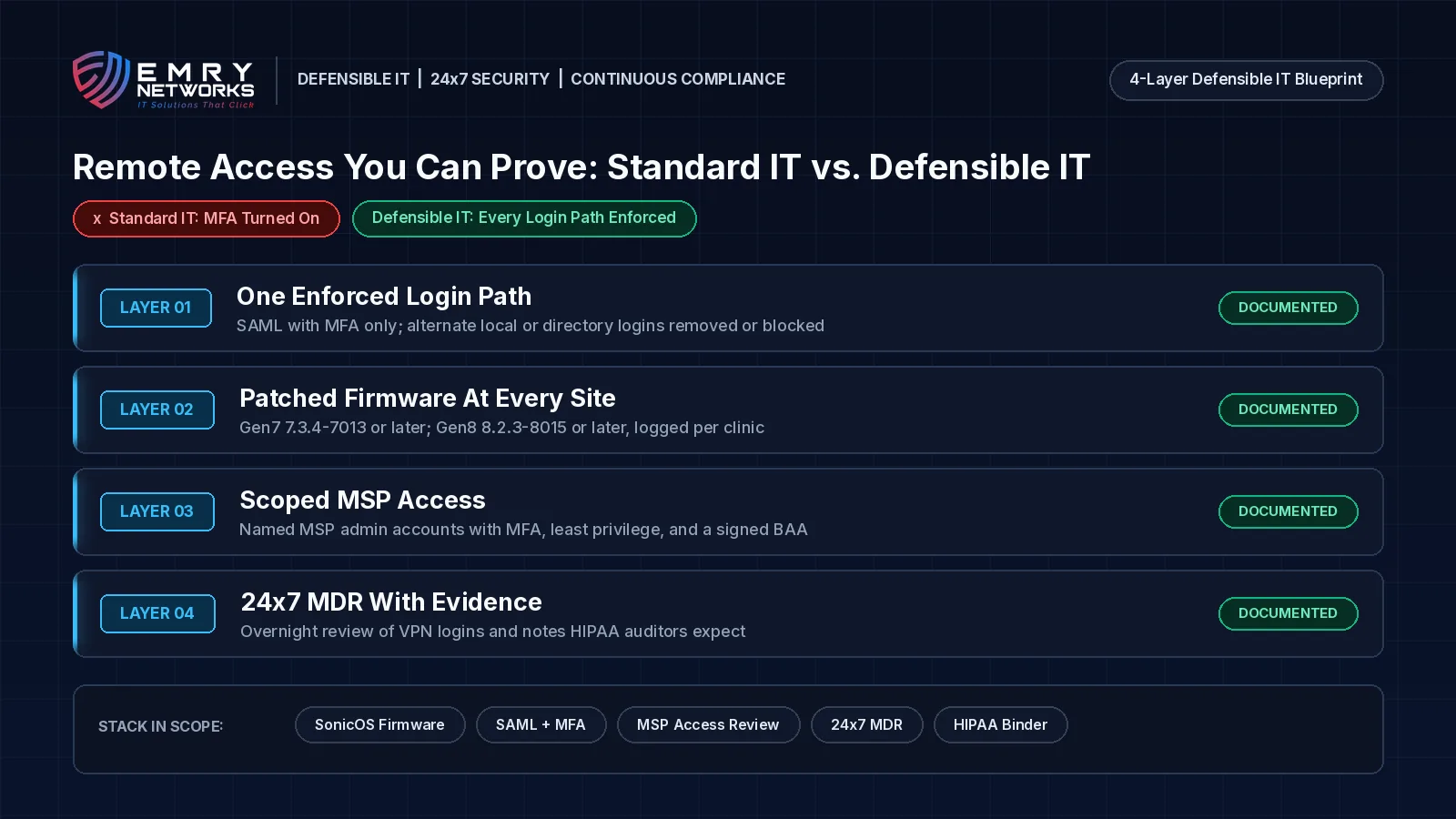
Standard IT turns MFA on once and patches when someone gets to it. Defensible IT can show every SSL-VPN login path per clinic firewall, the SonicOS build at every site, which MSP accounts can reach those firewalls, and who reviewed overnight VPN logins.
Standard IT says "MFA is on." Defensible IT can show the SAML-only login-path review, the per-site SonicOS patch record, the named MSP access list, and the 24x7 case notes, with dates.
Standard IT looks like this:
- MFA enabled at setup and never re-checked.
- Firewalls at each clinic on whatever firmware was current when they were installed.
- Shared or unnamed MSP admin logins.
- No dated per-site list of remote login paths when an auditor asks who can log in.
Defensible IT looks like this:
- One enforced login path per firewall, SAML with MFA, reviewed on a schedule through compliance-first managed IT services.
- Firmware tracked per site, with CISA KEV items treated as urgent (the November 20th, 2026 date is the federal civilian deadline and a useful private-sector benchmark, not a HIPAA statutory clock).
- Named, least-privilege MSP accounts with MFA, covered by a BAA.
- 24x7 managed detection and response so an odd 2 a.m. VPN login gets a human response that night, with dated notes saved to your HIPAA evidence folder.
How does Emry Networks help regulated businesses in Jacksonville FL, Manchester NH, and nationwide?
Emry Networks provides managed IT, cybersecurity, and compliance services for medical and dental groups, law firms, financial advisors, SaaS vendors, defense contractors, and other regulated industries. We serve regulated SMBs nationwide from hubs in the Jacksonville, FL and Manchester, NH areas. Pricing is all-inclusive and flat monthly, so overnight incident response does not bring a surprise invoice. Every engagement follows the 3-phase Emry Assurance Roadmap (often delivered as a 90-day blueprint):
- Phase 1 - Red Zone (Regulatory Discovery): Inventory firewalls, VPN login paths, and privileged MSP access; map gaps to HIPAA Security Rule expectations; deploy EDR, logging, and device management.
- Phase 2 - Transition (Security Hardening Sprint): Remove extra SSL-VPN login paths, enforce SAML with MFA, route VPN alerts to 24x7 coverage, and write policies that match what actually runs.
- Phase 3 - Green Zone (Continuous Management & Drift Control): Retest that every login path enforces MFA, confirm firmware stays current, and hand you dated before-and-after evidence for the compliance binder.
Not sure every clinic firewall would pass this check? Book a 30-Minute Risk Assessment. In thirty minutes we review remote-access login paths, patch evidence, and MSP access, then tell you plainly what we find. Prefer the phone? Call (603) 202-3200.
What are the next steps for your medical group?
- Book a 30-Minute Risk Assessment with our team. Prefer the phone? Call (603) 202-3200.
- Take the free Compliance Readiness Assessment to see where you stand.
- Read our guide on which compliance framework applies to your business.
Frequently asked questions
What is the SonicWall CVE-2026-19868 vulnerability?
It is a SonicOS SSL-VPN authentication enforcement flaw. On setups that use SAML sign-in, a user with valid credentials for an alternate authentication method may bypass SAML controls and SAML-enforced MFA. SonicWall patched it on November 6th, 2026.
Is CVE-2026-19868 being exploited?
SonicWall investigated a report of potential exploitation. CISA added the flaw to its Known Exploited Vulnerabilities catalog on November 6th, 2026, with a November 20th, 2026 federal deadline.
Which SonicOS versions fix it?
Gen7 7.3.4-7013 and Gen8 8.2.3-8015, according to reporting that cites SonicWall PSIRT SNWLID-2026-0014. Affected builds are Gen7 7.3.3-7015 and earlier and Gen8 8.2.2-8015 and earlier. That reporting also says SonicWall lists no workaround.
What should a medical group ask its MSP?
Which firmware each clinic firewall runs, whether SAML with MFA is the only SSL-VPN login method at every site, which local or directory VPN accounts remain, which MSP accounts can reach the firewalls, and who reviews VPN logins overnight.
How does 24x7 MDR differ from a business-hours ticket queue?
A business-hours queue may not see an odd 2 a.m. VPN login until the next morning. 24x7 managed detection and response puts a person on that alert the same night and leaves dated evidence for your HIPAA file.
Next steps
See how we help businesses in your industry, or book a short call to talk through where you stand today.
Read more from our team
Explore insights on compliance and security.

Ready to strengthen your compliance?
Get hands-on assessment and guidance from our compliance experts.