
Veeam Backup Credentials and 3AM Ransomware: Monday Morning Drift Checks

Bitdefender research published about November 3rd, 2026 describes a 3AM (ThreeAM) ransomware affiliate intrusion into a UK school estate. On September 10th through 11th, 2026 the attacker read stored credentials from the databases of three Veeam backup servers. Backdoor domain-admin accounts followed. On September 18th the attacker joined three separate domains with two-way trusts within about three hours. On September 19th machines were encrypted and system-state backups deleted. Bitdefender found no novel tools. Command tempo suggested a hybrid human/AI loop, presented as a working model, not an established fact. (Bitdefender)
For SaaS and B2B technology vendors that must show SOC 2 or ISO 27001 evidence for privileged access, backup integrity, and change monitoring, this is a clear test of whether anyone notices backup-credential reads and unexpected domain trusts. Here is the Monday-morning drift check to run this week.
Watch the 60-Second Briefing: Watch our narrated YouTube Short on the 3AM Veeam credential-theft case and the Monday drift-check playbook on YouTube (@emrynetworks).
Executive takeaway
- What happened: A 3AM affiliate stole credentials from three Veeam backup databases (September 10th-11th, 2026), built two-way trusts across three domains in about three hours (September 18th), then encrypted and wiped system-state backups (September 19th). (Bitdefender)
- What to detect: Credential-reading access to backup databases; new domain trusts; SAM/SYSTEM/SECURITY hive exports outside known jobs.
- What to do: Run a 15-minute Monday drift check, scope backup accounts per domain, and confirm who answers those alerts overnight.
- Standard IT vs. Defensible IT: Standard IT celebrates that backups exist. Defensible IT proves who read them and keeps 24x7 evidence for SOC 2.
What happened in the Bitdefender 3AM case?
Bitdefender attributes the intrusion to a 3AM ransomware affiliate and documents a living-off-the-land operation: PowerShell, WMI, reg, netsh, rundll32, Impacket-style remote execution, Mimikatz, and a published Veeam credential script. Initial access was not established. Earlier January and June 2026 activity was noted with an unconfirmed relationship to the September timeline. (Bitdefender)
How were the Veeam credentials stolen?
On September 10th through 11th, 2026 a modified copy of a public Veeam credential tool read the credentials stored in the backup software databases on three backup servers and decrypted them with DPAPI. That was the first recorded September move. Backup accounts that can reach multiple domains become a cross-domain key once stolen.
Why do new domain trusts matter?
On September 18th, within a roughly three-hour window, the attacker created two-way trusts between three previously separate Active Directory domains using netdom and dnscmd, then pushed backdoor account access across the estate. A new trust is a rare, high-privilege change. It is cheap to alert on and expensive to miss.
What about the AI angle?
Bitdefender describes retries arriving about every 40 to 101 seconds with small changes, and presents a hybrid human/AI loop as the working model defenders should plan around, not as an established fact. Telemetry could not prove which model ran, or whether a person was pasting between a shell and a chat window. Keep that caveat in any briefing. The detections below do not depend on resolving the AI debate.
Why does this matter for a SaaS or B2B vendor?
Your SOC 2 report and ISO 27001 program expect control evidence for privileged access, backup integrity, and change monitoring. Auditors do not accept "the backup job was green" as proof that nobody read the credential store or that no unexpected domain trust appeared.
Hybrid cloud and multi-domain estates make the same mistake the school estate made: privileged backup credentials and separate domains without trust change control. Defense contractors and other regulated buyers map similar expectations under NIST SP 800-171 and the NIST Cybersecurity Framework. Our guide to which compliance framework applies to your business covers how these overlap.
Is a quarterly backup restore test enough?
A restore test proves recovery. It does not prove that backup databases were unread, that trusts were unchanged, or that hive exports were limited to known jobs. Drift checks and restore tests answer different questions. Emry does not claim one fixed full-server restore cadence for every client; restore frequency follows each client's risk appetite, framed as the minimum you accept and the cadence we run.
What is the Monday morning 15-minute drift check?
Ask for dated answers in writing.
- Who read backup databases this week outside known jobs? List the accounts, hosts, and timestamps.
- Were any new domain trusts created, and who approved them? Match every trust to a change ticket.
- Any SAM/SYSTEM/SECURITY hive exports outside known admin jobs? Flag unknowns.
- Are backup accounts scoped per domain, with immutable recovery copies no domain account can delete?
- If those alerts fire at 2 a.m., who answers, and where is that logged? Name the person or MDR team and the evidence location.
- Save the answers. Put the written replies, dates, and reviewer name in your SOC 2 evidence folder.
What if you already saw a backup-cred read?
Treat the backup tier as compromised until proven otherwise. Rotate backup credentials from a known-good path, isolate backup servers, preserve logs before cleanup, verify trusts and domain-admin membership, and open incident response. Confirm immutable copies still exist outside the attacked domain.
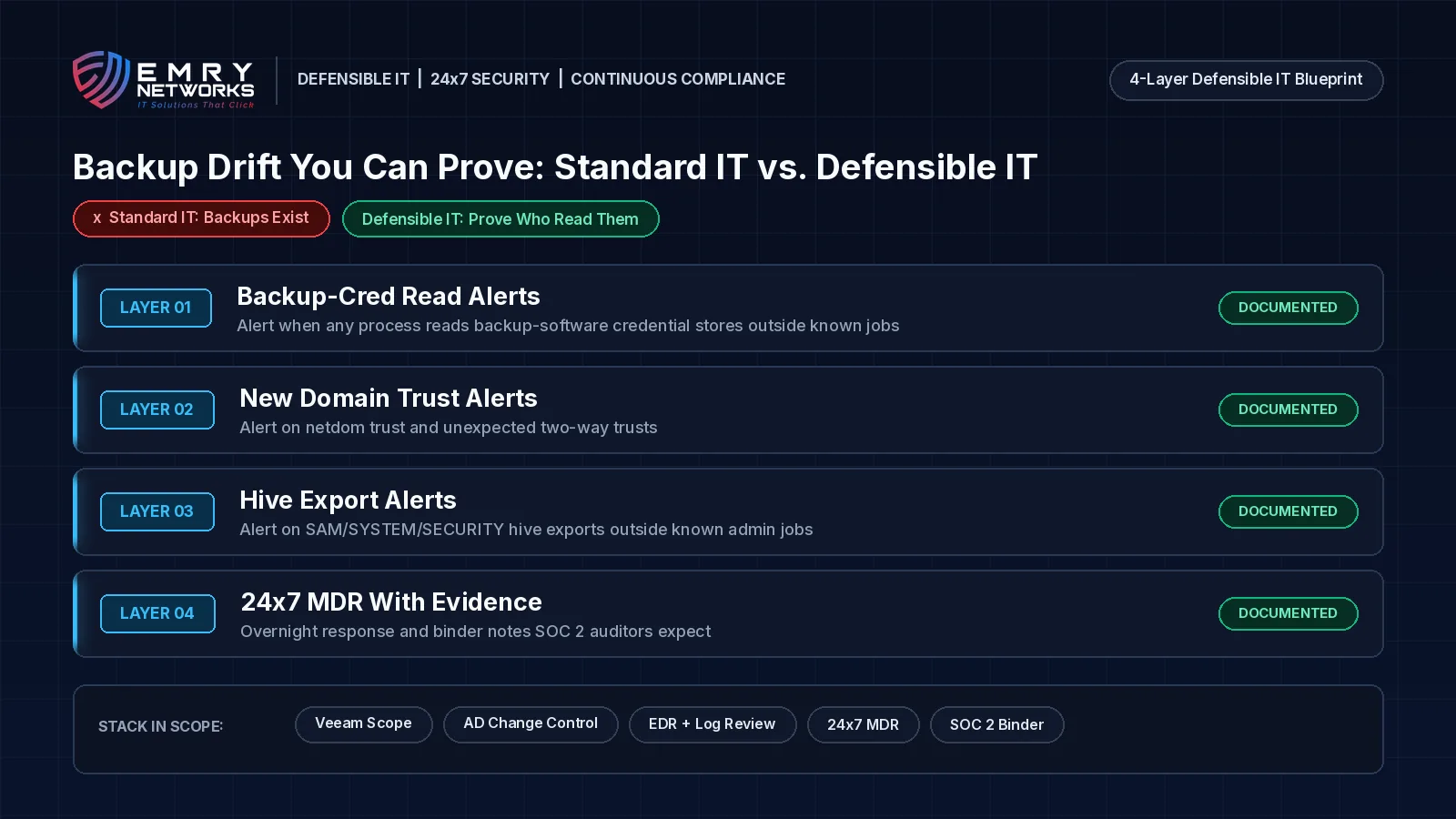
Standard IT vs. Defensible IT
Standard IT celebrates that backups exist and reviews alerts in the morning. Defensible IT can show who read backup credential stores, which trusts changed, which hive exports ran, and who watched overnight.
Standard IT says "backups are green." Defensible IT can show the credential-read alert, the trust change ticket, the hive-export review, and the 24x7 case notes, with dates.
Standard IT looks like this:
- Backup success emails treated as the finish line.
- Domain trusts and backup admin rights without change control.
- Credential-store and hive-export activity reviewed during business hours only.
- Thin evidence when a SOC 2 auditor asks who can read backup secrets.
Defensible IT looks like this:
- Alerts on backup-database credential reads, new domain trusts, and unexpected hive exports, delivered through compliance-first managed IT services.
- Backup accounts scoped per domain and immutable recovery copies no single domain account can delete.
- Trust and domain-admin changes behind change control.
- 24x7 managed detection and response so a 2 a.m. backup-cred alert gets a human response that night, with notes that land in the compliance binder.
How does Emry Networks help regulated businesses in Jacksonville FL, Manchester NH, and nationwide?
Emry Networks provides managed IT, cybersecurity, and compliance services for SaaS vendors, medical and dental groups, law firms, financial advisors, defense contractors, and other regulated industries across the United States, from hubs in the Jacksonville, FL and Manchester, NH areas. We work on all-inclusive flat monthly pricing, so an overnight incident response does not bring a surprise invoice. Every engagement follows a 90-day blueprint:
- Phase 1 (Days 1-30): Scoping, a baseline gap assessment, and software deployment. We inventory backup systems, domain trusts, and privileged paths, confirm MFA strength, and deploy EDR, logging, and device management.
- Phase 2 (Days 31-60): Tool implementation and policy authoring. We scope backup accounts, route credential-read and trust alerts to 24x7 coverage, and write policies that match what actually runs.
- Phase 3 (Days 61-90): Verification and a second gap assessment. We test that drift alerts reach a person at any hour, confirm fixes, and hand you before-and-after evidence.
Not sure your backup tier would survive a credential-read and trust push? Book a 30-Minute Risk Assessment. We will review backup scope, trust change control, and after-hours alert paths, and tell you plainly what we find. Prefer the phone? Call (603) 202-3200.
Next Steps for Your Business
- Take the free Compliance Readiness Assessment to see where you stand.
- Read our guide on which compliance framework applies to your business.
- Book a 30-Minute Risk Assessment with our team.
Frequently asked questions
What happened in the Bitdefender 3AM ransomware case?
A 3AM affiliate stole credentials from three Veeam backup databases on September 10th through 11th, 2026, built two-way trusts across three domains in about three hours on September 18th, and encrypted machines while deleting system-state backups on September 19th.
Was this proven to be an AI-operated attack?
No. Bitdefender presents a hybrid human/AI loop as a working model based on command behavior, not as an established fact. Keep that caveat.
What should a SaaS vendor check every Monday?
Who read backup databases outside known jobs, whether any new domain trusts appeared, whether hive exports ran outside admin jobs, and who answers those alerts overnight.
Do we need a ransom amount to act?
No. Bitdefender's public write-up does not require a disclosed ransom figure for the detections. Do not invent one.
How does 24x7 MDR differ from a business-hours ticket queue?
A business-hours queue may not see a 2 a.m. backup-credential alert until the next morning. 24x7 managed detection and response puts a person on that alert the same night and leaves dated evidence for your SOC 2 auditor.
Next steps
See how we help businesses in your industry, or book a short call to talk through where you stand today.
Read more from our team
Explore insights on compliance and security.

Ready to strengthen your compliance?
Get hands-on assessment and guidance from our compliance experts.